Keep a supplement purchase record that can answer a real question
Save the matching label, checkout, seller and receiving information so that a later price comparison or product question does not rely on memory.
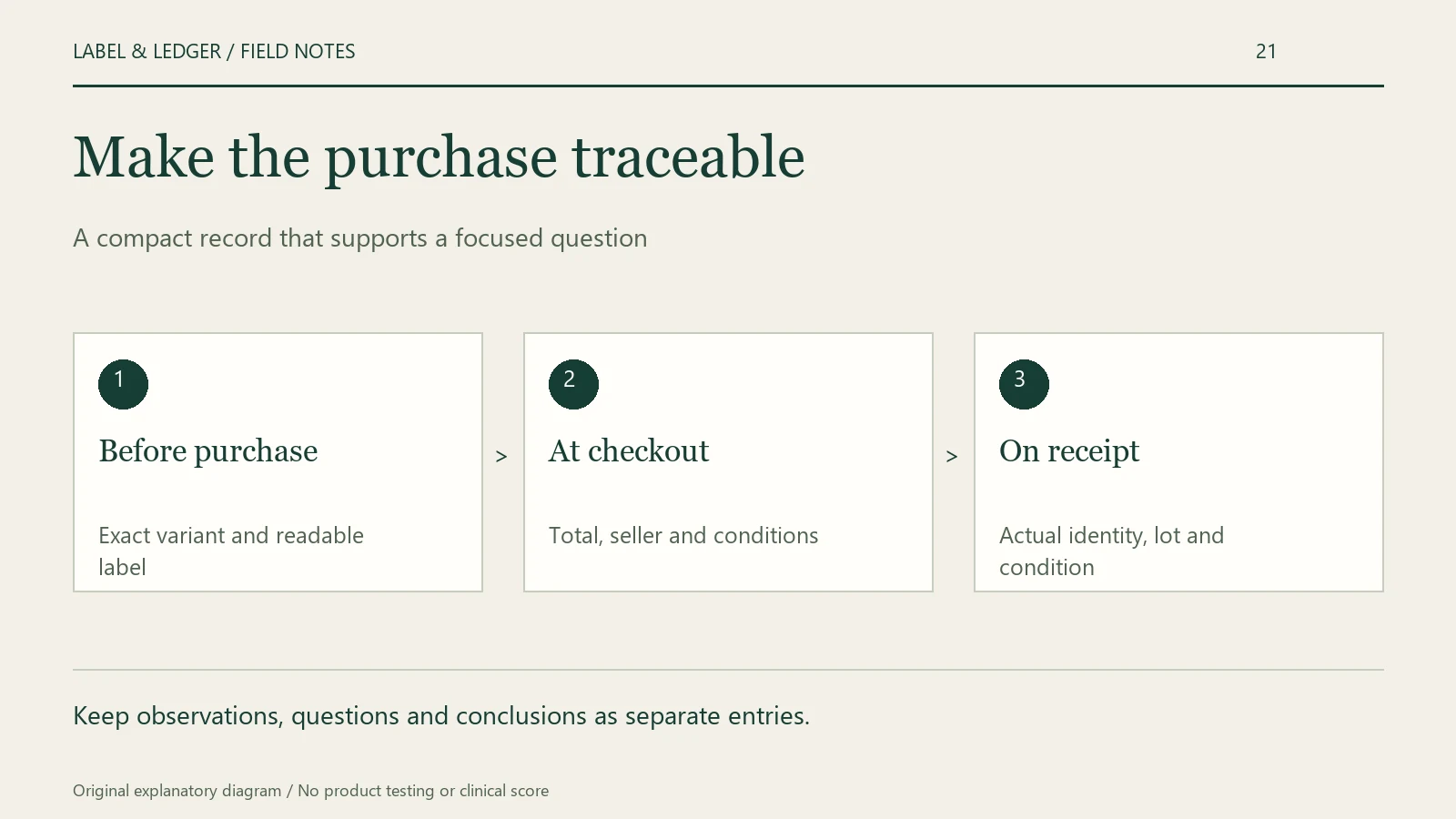
A useful supplement purchase record connects the exact product, the information used to choose it and the package actually received. Save a readable label, selected variant, checkout total, seller and relevant order conditions. Then add factual receiving details. This helps you repeat a price calculation or ask a focused question later. It is practical recordkeeping, not proof that a product is genuine, safe or effective.
Save the decision inputs together
Keep the product-page capture and current label in the same folder or note as the checkout. Name the record so you can distinguish package sizes and variants. A generic file called supplements is less useful when several purchases accumulate. Include your own capture date without claiming the seller or manufacturer reviewed the information on that date.
Write the exact seller separately from the product brand. Record the selected quantity and whether the offer is one-time or recurring. If a comparison relied on a particular ingredient amount, preserve the readable panel that supplied it. This makes it possible to check whether a later difference came from a changed formula, a changed package size or a price change.
Preserve the full price calculation
Record item subtotal, immediate dollar discount, shipping, tax and any other charge shown. If your worksheet allocates shared order charges, save the method as well as the amounts. Keep the original order total for reconciliation. A unit-cost result without its inputs is difficult to audit and can become misleading when copied into another comparison.
For an illustrative record, a $24 item plus $4 allocated charges minus $3 discount produces a $25 net package cost. If the label has 50 servings, unit cost is $0.50. Save all five inputs and the formula, not only the result. These are invented demonstration numbers; use your own checkout record for an actual purchase and avoid treating this example as an observed offer.
Record conditions that could matter later
If the purchase involves a subscription, save the stated interval, later price conditions and cancellation instructions that apply to the selected offer. If it involves a bundle, identify every included item. If it relies on a future reward, keep that separate from the cash paid today. The point is to preserve the actual terms you saw, not to assume every seller uses the same rules.
| Record component | Minimum useful detail | Later question it supports |
|---|---|---|
| Product identity | Name, form, variant and count | Did I compare the same package? |
| Label | Readable full panel | Which amount supplied the denominator? |
| Checkout | Total and charge components | Why did the unit cost change? |
| Seller | Order source and confirmation | Who handles the transaction question? |
| Conditions | Relevant recurring or bundle terms | What did the selected offer require? |
| Receiving | Actual package details | Did the received item match the order? |
Do not collect sensitive information merely because a table has room for it. A shopping record does not need a full medical history or complete payment-card number. Keep private health questions in an appropriate separate record for your healthcare professional. This website does not receive your purchase ledger, and its calculators do not require identity information.
Add factual receiving observations
When the package arrives, compare its name, count and formulation with the order. Preserve lot and date information if shown, and note any condition concern using plain observations. A photograph can document what you saw, but it does not diagnose a defect or establish the package's history. Avoid asserting how an issue occurred when you only know its appearance on receipt.
Follow the actual storage instructions. If a package seems questionable, ask the appropriate seller or manufacturer and obtain professional advice for health concerns. Do not use a low price or a successful order confirmation as evidence that the product's condition is acceptable. Purchasing, receiving and deciding on use are separate stages with different information needs.
Keep changes as new entries
When a label or price changes, add a new version rather than overwriting the old one. A later comparison can then distinguish formulation change from inflation, discount changes or delivery-cost changes. Preserve the original record even if the seller page disappears. A dead link does not erase your observation, but your capture should still be described as what you saw at that time rather than a current offer.
If you discover that you used the wrong label image, correct the calculation and note the reason. Do not silently retain a favorable result from mismatched inputs. An error log can be as simple as one sentence identifying the old input, replacement input and resulting difference. The goal is reproducibility, not a perfect-looking history.
Use the record for a focused inquiry
A manufacturer question should identify the exact formulation and unclear label statement. A seller question should identify the order and transaction issue. A healthcare question should include the actual product and relevant personal circumstances. The same purchase folder can support each conversation, but only send the information appropriate to that recipient. Do not attach unrelated private records to a general product inquiry.
If a suspected health problem occurs, prioritize care and follow FDA's current reporting instructions where relevant. Your shopping record may supply useful product details, but it is not a safety report by itself. Keep any official submission confirmation separately and avoid treating it as an agency finding. The distinction between observation, question and conclusion should remain clear throughout the record.
Review what is still worth keeping
Periodically remove unnecessary duplicates and protect private records using tools appropriate to your device. This guide does not impose a universal retention period or give legal recordkeeping advice. Keep enough information for the questions you reasonably expect to revisit. The most useful record is often compact: a matching label, checkout, confirmation and brief receiving note, with clear dates and scope.
FAQ
Do I need to send this information to the website?
No. Keep it privately. The tools run locally and need only arithmetic inputs, not your receipt or health history.
Does a receipt establish product quality?
No. It documents a transaction. Quality, condition, suitability and claim support require separate information.
Should I overwrite an old comparison when prices change?
Preserve a dated version and add the new observation. That makes the reason for a difference easier to understand.
Sources
- FDA: How to report a problem with dietary supplements — official reporting route when relevant. The purchase-record structure above is an original practical workflow.