How to check a supplement claim without turning reviews into evidence
Turn an advertisement into a clear research question and separate the exact product claim from testimonials, ingredient background and original research.
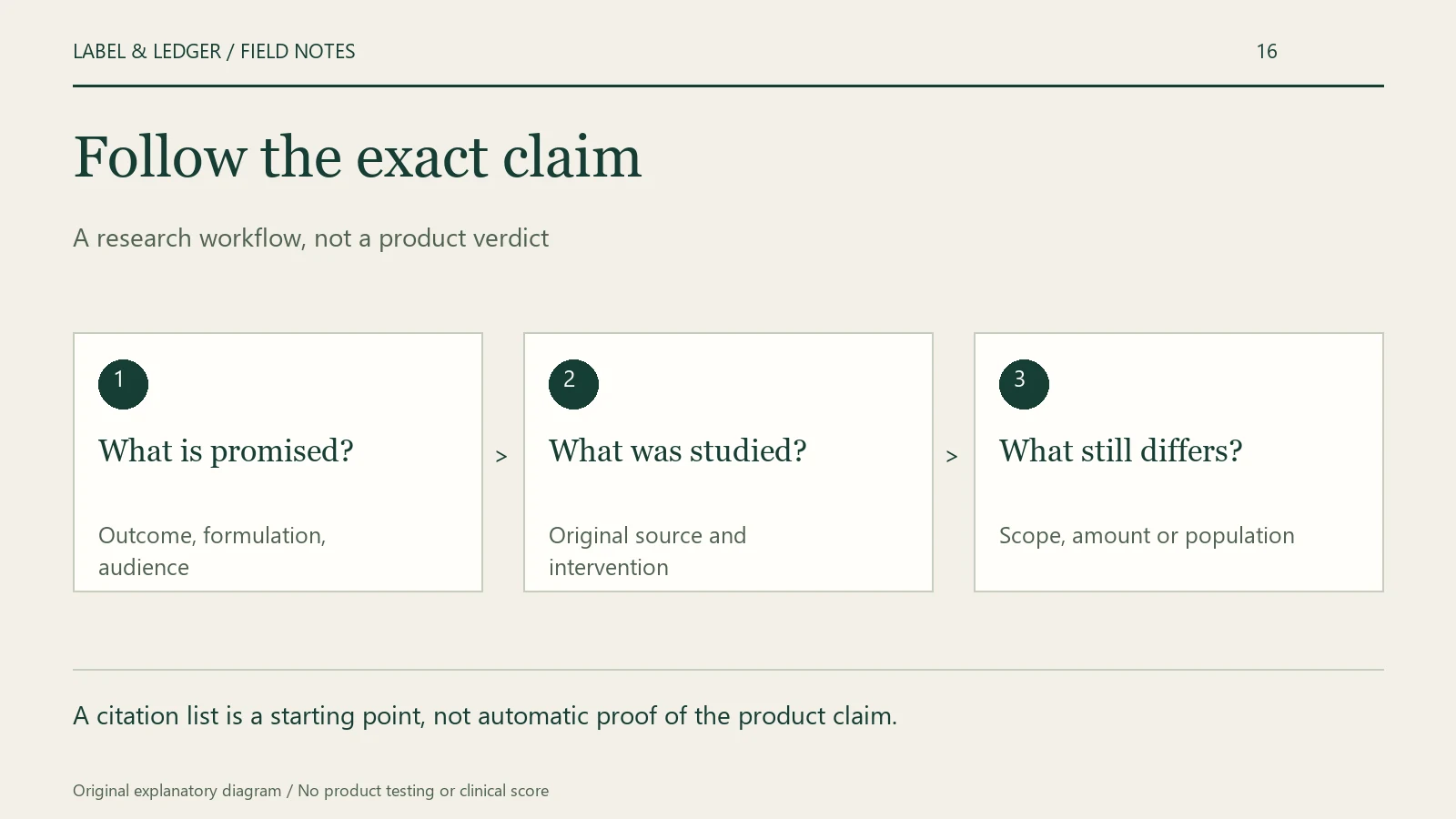
To investigate a supplement claim, first write down exactly what is promised, for which product and for whom. Then ask whether the supporting material addresses that same claim. Keep testimonials, general ingredient explanations and product-specific research in separate categories. This workflow helps identify gaps; it does not make a clinical judgment or guarantee that a product works. Bring claims that would affect medical decisions to a qualified healthcare professional.
Capture the claim in its original context
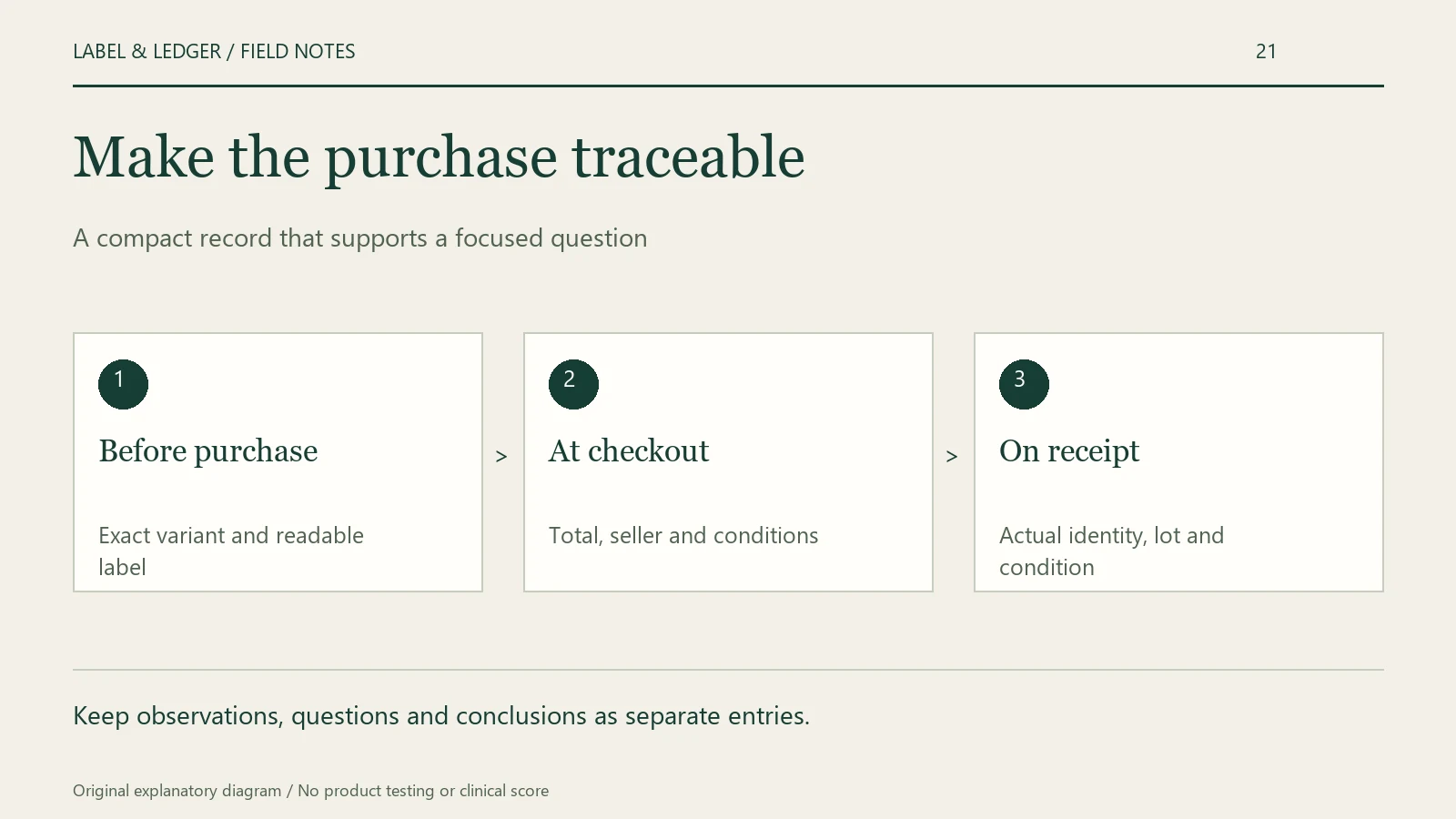
Save the full advertisement or product page rather than a shortened phrase. A headline, qualification and image can work together to imply an outcome. Record the exact variant and any stated conditions. If you later ask a question, a full capture helps distinguish what the seller actually said from what you remember it saying. Do not publish another person's private information as part of that record.
Write a neutral version of the question: does the offered formulation have evidence for the stated outcome in the described circumstances? This avoids beginning with either approval or dismissal. It also makes it easier to see when the supplied material answers a different question, such as whether a component has a biological role rather than whether the marketed product produces the advertised result.
Separate the types of support
An ingredient fact sheet gives background. A testimonial describes an individual's reported experience. A laboratory experiment examines a particular setup. A study involving people has its own population, intervention and outcomes. These categories should not collapse into a single evidence provided checkbox. Record what each source actually is, and leave its applicability open until you understand the connection.
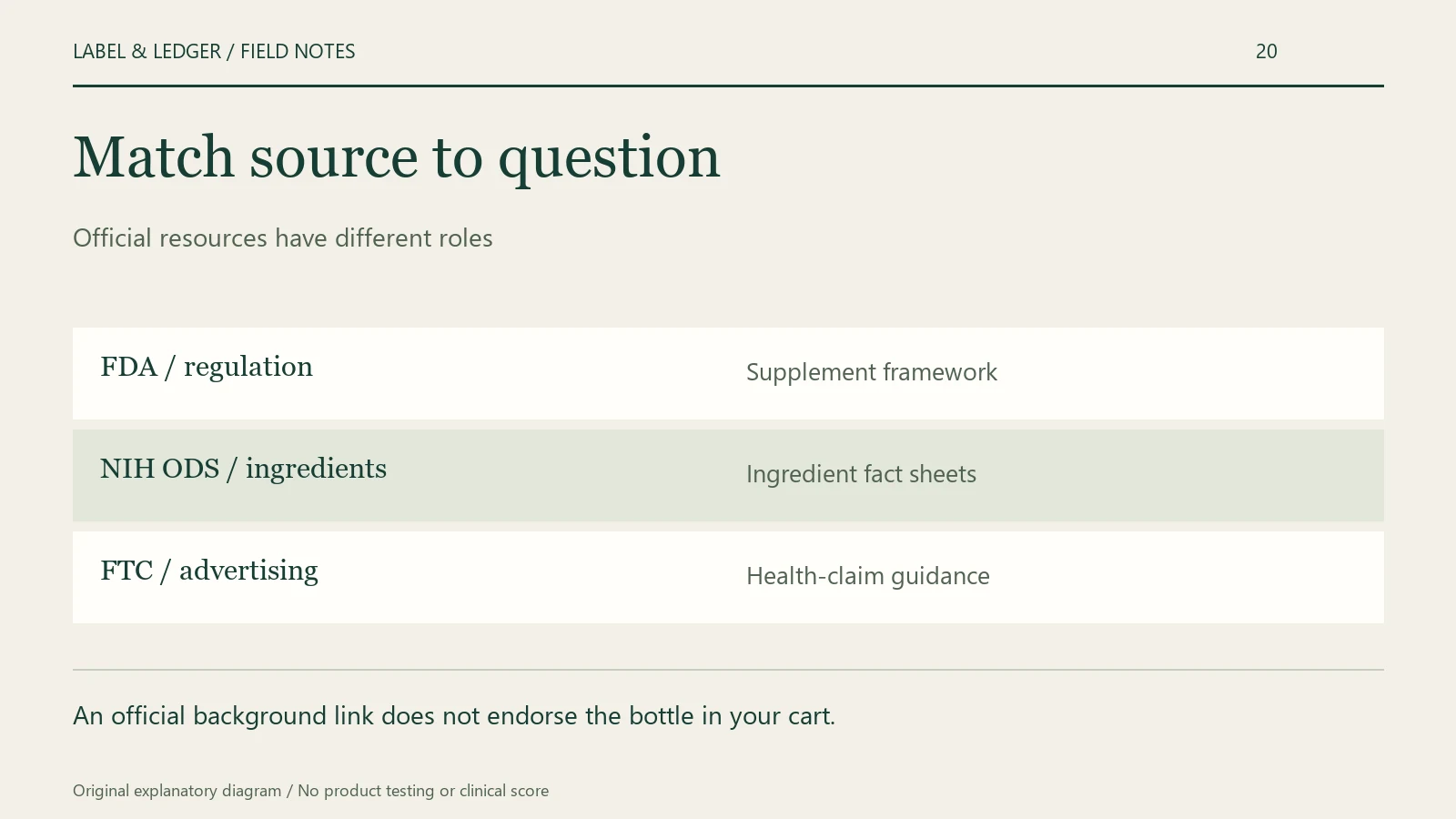
FTC's Health Products Compliance Guidance is an official reference for how advertisers should substantiate health-related representations. Use it to understand the importance of the claim and its support, not as a shortcut to declare a specific advertisement lawful or unlawful. This website does not provide legal advice or conduct an enforcement assessment of individual sellers.
| Material offered | Question to ask | Gap to keep visible |
|---|---|---|
| General nutrient page | Does it address this promised outcome? | Background may not evaluate the product |
| Customer review | What can be verified beyond the account? | Reported experience is not a controlled comparison |
| Ingredient study | Does it match form and formulation? | Product may differ from intervention |
| Product study | Who participated and what was measured? | Applicability may be limited |
Follow citations to their original source
If an advertisement names a study, look for enough information to identify the original paper or official record. A title fragment and a cropped graph may not be sufficient. Ask the seller for the complete citation if needed. Keep the original conclusion separate from the seller's interpretation. A source that cannot be located should stay unverified in your worksheet.
Read beyond a striking sentence when you have access to the source. Note the intervention, comparison group, population, duration and measured outcome in plain language. If the design or results are outside your expertise, acknowledge that rather than turning a quick reading into an expert review. The useful next step may be a focused question for a professional, not a verdict.
Check formulation and quantity matching
Record whether the evidence concerns a named ingredient, a combination or the exact marketed formulation. Compare the form and amount described, where available, without inferring an unknown blend component. A study on a single ingredient does not automatically describe an undisclosed multi-ingredient mixture. If the seller claims equivalence, ask what supports that connection and preserve the response.
Do not copy a study amount into your own use plan. The purpose of reading intervention details is to understand whether the cited research matches the claim, not to prescribe to yourself. Personal suitability depends on circumstances a product page cannot fully assess. Discuss use, medicines and health conditions with an appropriate healthcare professional.
Distinguish evidence gaps from negative findings
Unable to verify is different from verified not to work. Your record should reflect the actual state of your investigation. For example, you may have an incomplete citation, a formulation mismatch or a result that addresses another outcome. Each is a specific reason to withhold a conclusion. Avoid replacing uncertainty with a sweeping statement about the entire ingredient category.
The same discipline applies to favorable findings. A result from one setting should not be generalized to every user, dose or product without support. This guide deliberately provides no universal scoring formula. A high count of citations is not a substitute for understanding whether they are relevant to the question being asked.
Keep price outside the evidence judgment
An expensive product does not acquire stronger evidence because its price feels premium. A cheap product does not become clinically equivalent because its unit cost is attractive. Finish the evidence question separately from the price worksheet. You can report that one entered product costs less per labeled serving while its advertised claim remains unverified. Those findings can coexist without forcing a single ranking.
If a claim would lead you to delay care or change a medicine, obtain appropriate professional guidance promptly. Do not let an online research exercise become a reason to postpone needed care. This site offers general information and original comparison methods, with no clinician review or product-testing credentials claimed.
FAQ
Are customer reviews useless?
They may describe reported experiences, but they should not be presented as controlled evidence that a product caused a health outcome.
Does a citation list prove the exact product claim?
Not by itself. Identify what each source examined and whether it matches the formulation, outcome and circumstances being advertised.
Can I decide legality from this checklist?
No. It organizes questions and sources. An enforcement or legal determination requires a different assessment.
Sources
- FTC: Health Products Compliance Guidance — official advertising substantiation guidance. The research worksheet above is an original educational method.