What to bring to a pharmacist when asking about supplements
Prepare exact labels, actual use and a complete product list so that a supplement consultation begins with clear information rather than a brand nickname.
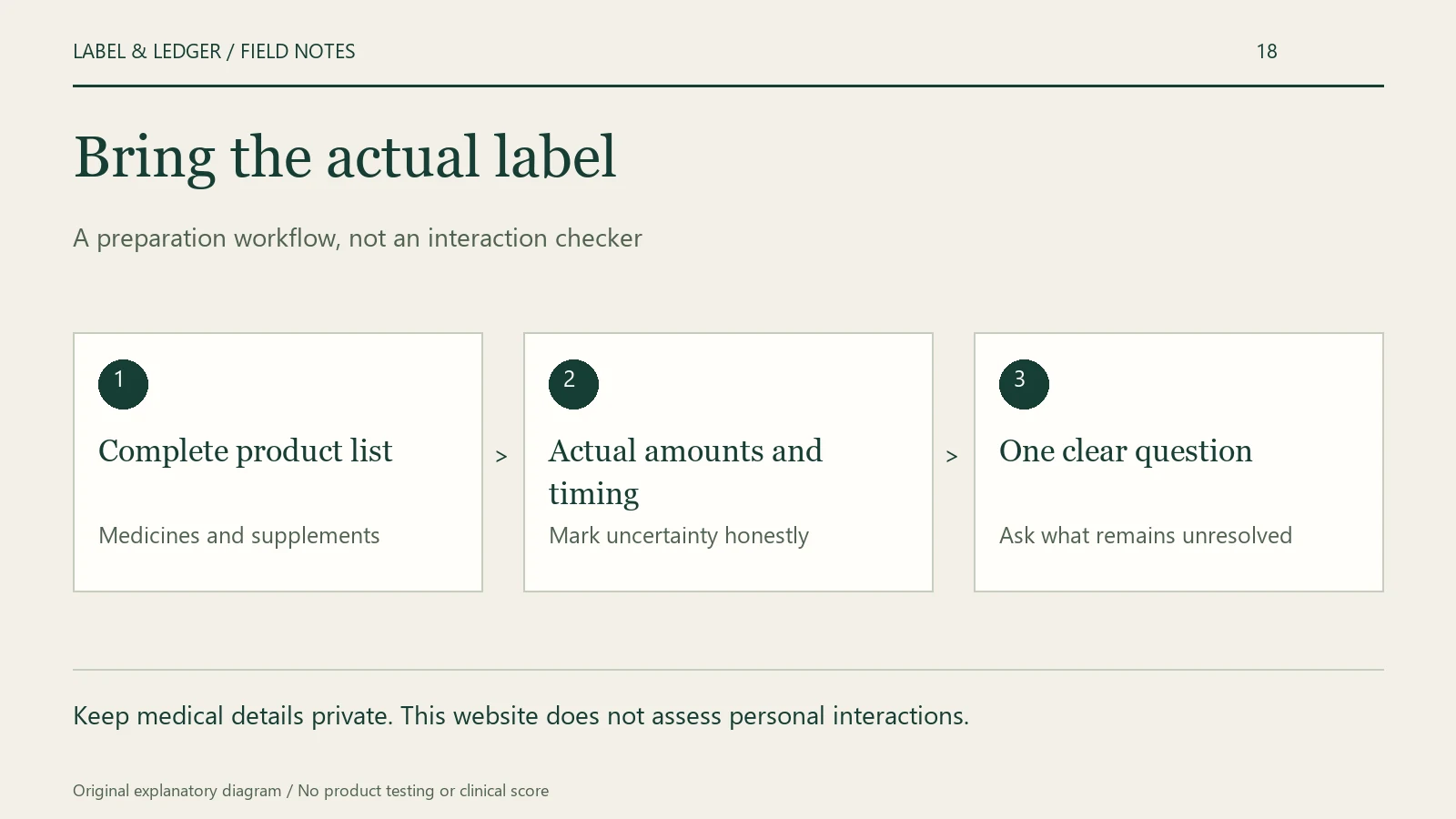
Bring the exact supplement labels, your actual use and a complete medicine and supplement list when asking a pharmacist or other qualified healthcare professional about suitability. State the question you want answered rather than asking whether a product is generally good. This guide helps organize a conversation; it does not screen interactions, set doses or supply an individualized safety assessment. Price calculations belong after the relevant personal-use questions are addressed.
Make the question specific
Write what you are considering and why you want to discuss it. For example, you may want to ask whether adding a particular product raises a concern with your existing medicines, or whether two labels overlap in a way that matters. These are question templates, not examples of safe combinations. The professional needs the actual circumstances to provide useful guidance.
Avoid beginning with a marketing category such as energy support or immune blend alone. Those names do not specify a formulation. Bring the full panel and other ingredients for the exact variant. If your information comes from a listing rather than a bottle, say so and note any uncertainty about the label version. Do not fill missing amounts from another product's page.
Prepare a complete product list
List prescription medicines, nonprescription medicines and supplements you actually use, with the relevant amounts and timing as accurately as you can. Include occasional products rather than only daily ones. If you are unsure of a name or amount, bring its package or a clear image and mark the uncertainty. This is your private preparation; do not submit sensitive details to this website.
NCCIH's guidance on using supplements wisely discusses the importance of talking with healthcare providers and the possibility of interactions. A short, accurate product list makes that discussion more concrete. It is not a self-administered interaction database. This site does not decide that an absent warning means a combination is safe, and it cannot assess your complete medical situation.
Keep declared amounts and actual use separate
Record what the label says per serving and how you actually use the product. If those differ, describe the difference honestly rather than rewriting one field to match the other. A professional may need to understand both. For an illustrative record format, a label column might show units per serving while an actual-use column shows the schedule you followed; no example amount here is a recommended regimen.
| Preparation item | What to bring | Why it helps the conversation |
|---|---|---|
| Exact product | Current full label or package | Identifies formulation |
| Actual use | Amount, timing and frequency | Distinguishes instructions from behavior |
| Other products | Complete medicine and supplement list | Exposes information that may be relevant |
| Main question | One clear written concern | Keeps the discussion focused |
| Missing facts | Unreadable or unknown label details | Prevents assumptions |
A vague statement such as I take a multivitamin can conceal different ingredient amounts across products. The same applies to powders, oils and blends. Preserve the exact brand and variant in your private list even though this website does not rank brands. Identity matters to the consultation without implying endorsement of that product.
Explain relevant circumstances without self-diagnosing
Tell the professional about relevant circumstances they ask about, such as planned procedures, pregnancy, breastfeeding, health conditions or a product intended for a child. This guide does not establish a complete screening list or determine which facts matter in your case. Answer honestly and ask what other information is needed. If you do not understand a question, ask for clarification rather than guessing.
If you are concerned about a symptom after using a product, describe what happened and when, and seek appropriate care. Do not use a scheduled shopping consultation as a reason to delay urgent help. For an emergency, call 911. The cost calculators cannot triage symptoms or determine whether a supplement caused them.
Ask for an actionable next step
At the end of the conversation, make sure you understand what has been answered and what remains unresolved. You might need a manufacturer clarification, a discussion with another clinician or a review of an exact ingredient quantity. Ask where to obtain the missing information and how to follow up. Do not treat an unfinished conversation as a blanket approval of every similar product.
Keep a private note of the advice actually given, its conditions and who provided it. Do not invent a credential, quote or professional endorsement for a public review. If you later change products or learn that the label was different, return with the updated information. Advice about one formulation should not silently become advice about a different package.
Bring cost into the conversation appropriately
If affordability is part of your concern, show the full checkout and supply calculation after explaining the use question. A lower unit cost may not solve the problem if formulations differ or if buying bulk requires unaffordable cash today. Ask whether the options you have identified are relevant rather than presenting the cheapest row as clinically equivalent.
The worksheet can help describe a constraint without determining treatment. For example, it can show that a particular purchase requires a larger upfront payment or that a delivery schedule creates extra inventory. It cannot decide what medicine to change or whether a supplement is necessary. Keep the financial information precise while allowing the professional to address personal health questions.
FAQ
Can this site check my interactions instead?
No. It contains no individualized interaction checker and does not collect the medical history needed for such an assessment.
Should I bring occasional supplements too?
Include what you actually use and let the professional decide what is relevant. Do not omit something because it is not taken daily.
Can a price result justify a dose change?
No. A cost calculation is not a reason to change use. Discuss that separately with an appropriate professional.
Sources
- NCCIH: Using dietary supplements wisely — healthcare-provider discussions and interaction context.