Unused servings and label dates: what your supplement really costs to use
Keep declared supply separate from expected usable supply and model waste without inventing shelf life or changing storage instructions.
The price of a bottle divided by its declared servings describes advertised supply. The same price divided by the servings you actually expect to use describes a personal utilization scenario. Keep both figures, and label the second as an assumption. Do not invent a shelf life, treat a label date as a universal guarantee or change storage instructions to make a package seem economical. This guide is about cost accounting, not stability testing.
Keep facts and assumptions in different columns
The exact package label, stated servings and printed date are observations you can record. Your expected use, possible interruptions and unused fraction are assumptions. Separating them prevents a forecast from becoming an apparent product fact. A row that says 60 labeled servings and 45 expected used servings is clearer than a row that silently rewrites the package as containing 45 servings.
For an online purchase, distinguish a sample label image from the actual package received. The sample may not show the lot or date that will arrive. If remaining shelf life matters to a bulk decision, ask the seller for relevant information and preserve the response. Do not claim an expected date is guaranteed unless the offer actually supports that statement.
Calculate cost per expected used serving
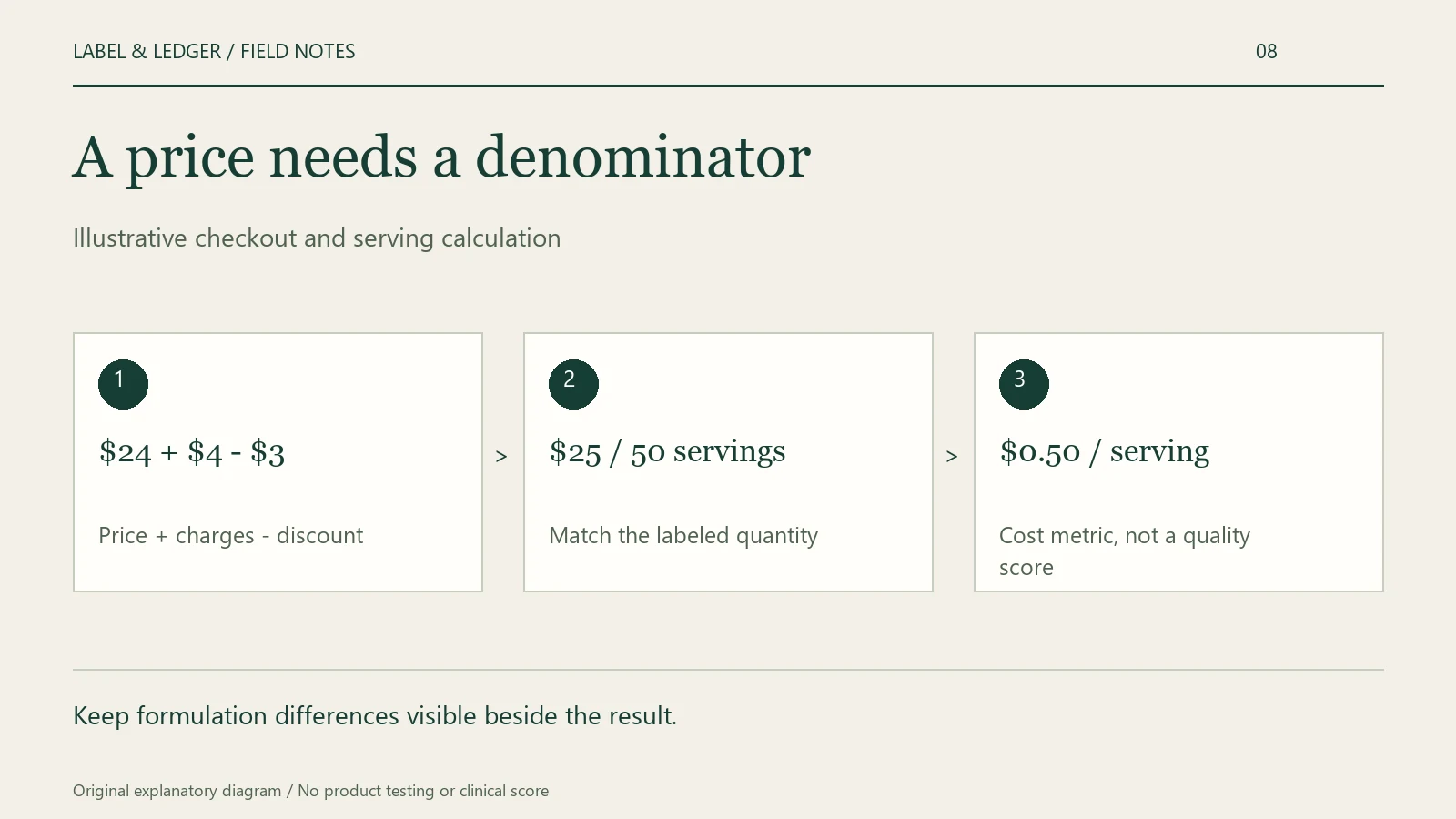
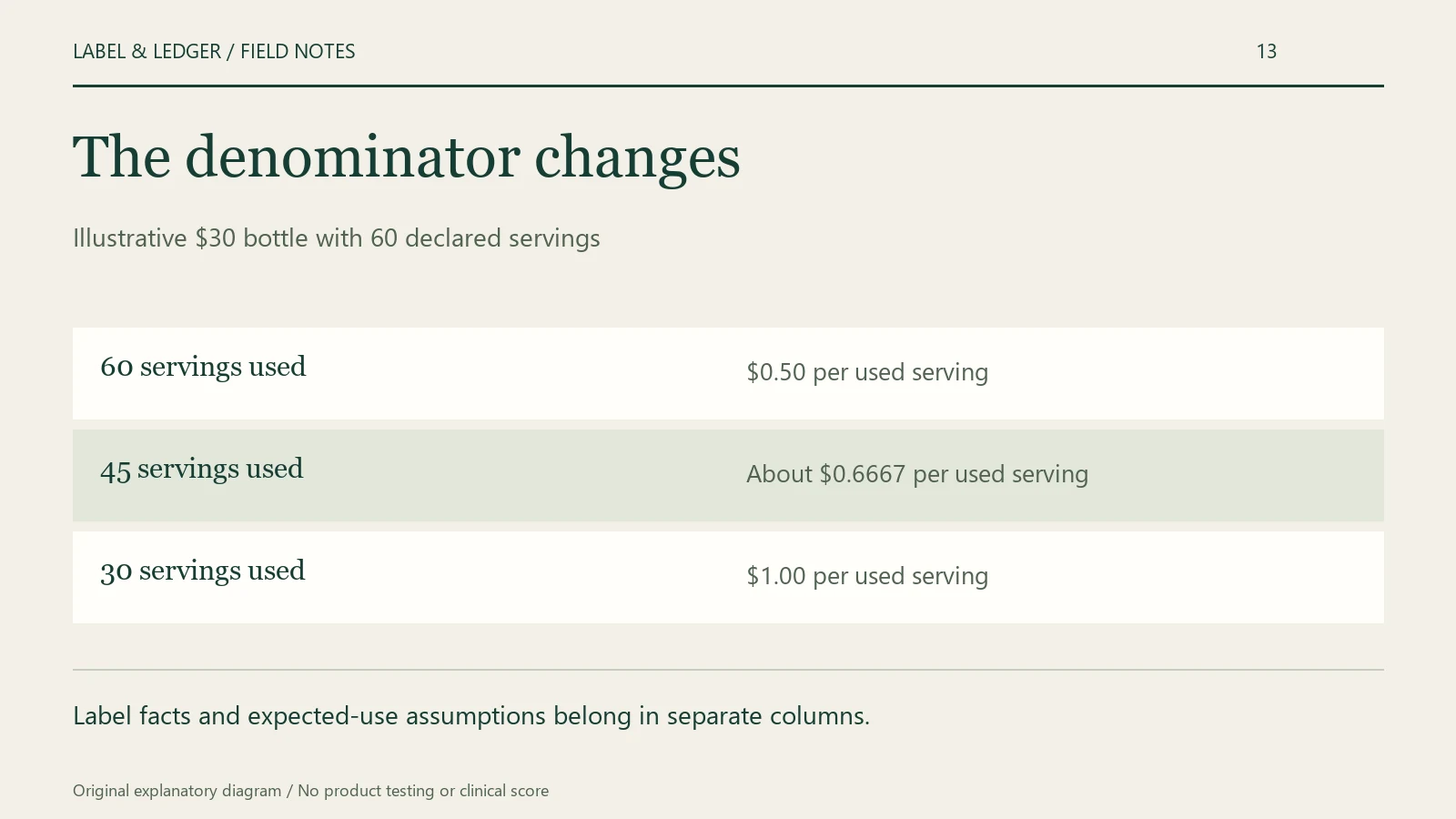
Consider an illustrative bottle costing $30 with 60 declared servings. Its declared cost per serving is $30 ÷ 60 = $0.50. If your scenario assumes 45 servings used and 15 left unused, cost per expected used serving is $30 ÷ 45, or about $0.6667. The bottle price has not changed. The denominator now describes the portion you expect to use.
If you use all 60, the metrics coincide at $0.50. If you use none, cost per used serving is undefined, not zero. Record the $30 cash spent and zero servings used without dividing by zero. This distinction matters because a spreadsheet might otherwise display a misleading free result or hide the failed calculation in an error cell.
| Illustrative use scenario | Used servings | Unused servings | Cost per used serving |
|---|---|---|---|
| Full use | 60 | 0 | $0.50 |
| Three-quarter use | 45 | 15 | About $0.6667 |
| Half use | 30 | 30 | $1.00 |
Model a time window carefully
Start with inventory already on hand, not just the new bottle. If an appropriate existing plan uses one serving per day and you already hold 20 servings, those servings affect when you would open the next package. This is a budgeting example, not a suggested schedule. Write the expected sequence so a large order does not appear immediately usable simply because it has arrived.
Use the actual label and manufacturer instructions to frame storage and date questions. This website does not determine whether a product remains acceptable after a particular date or exposure. If package condition or storage history raises a concern, ask the manufacturer or an appropriate professional rather than assigning a guessed remaining number of usable servings. Cost arithmetic cannot validate product condition.
Treat uncertain use as a range
If you are unsure whether you will continue using a product, calculate multiple plausible utilization scenarios. Choose the assumptions deliberately and say why they are relevant to you. Do not claim that one fraction is a population average; no such statistic is provided here. A range helps reveal whether a bulk discount depends heavily on using nearly every serving.
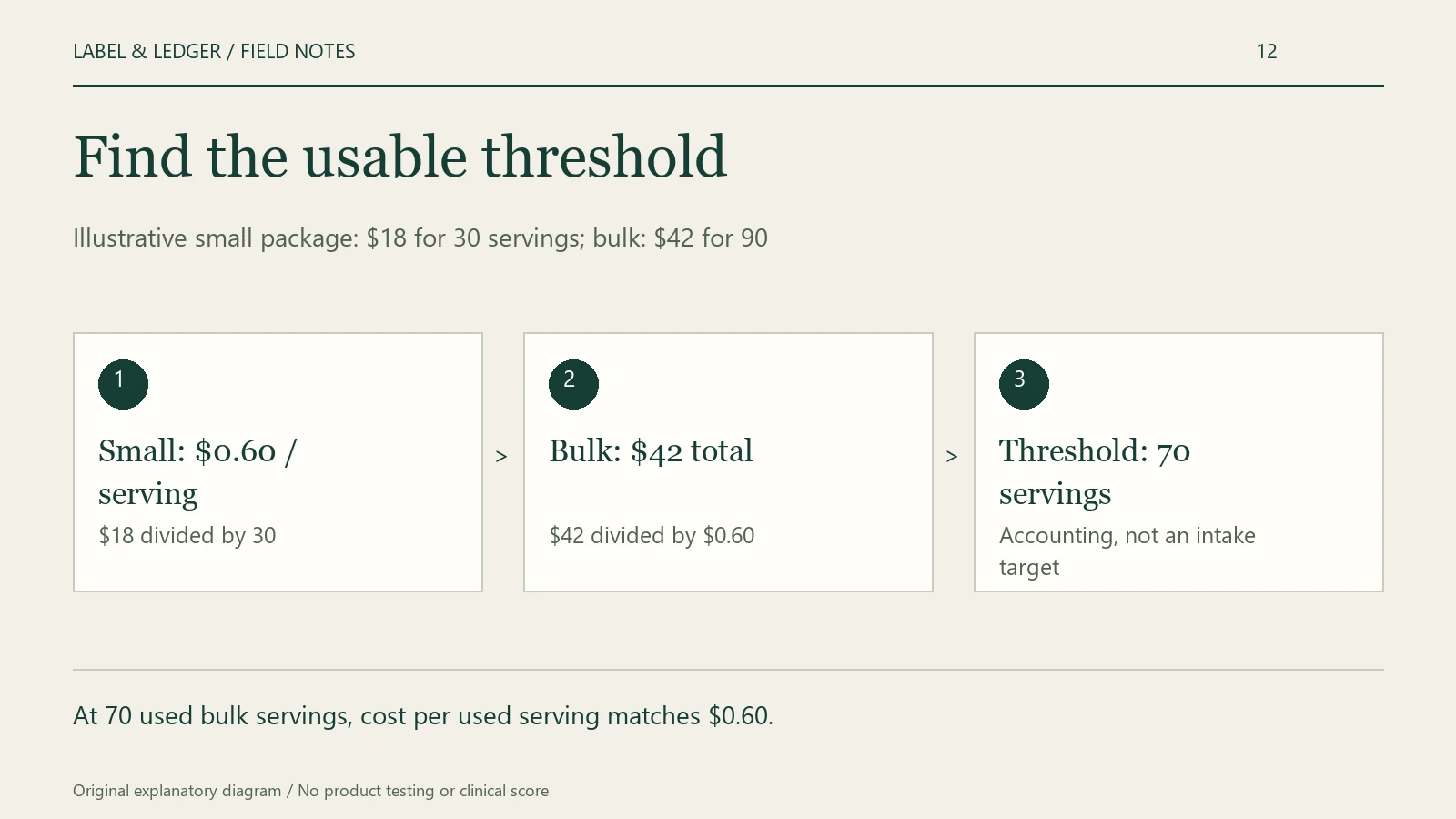
You can compare a smaller package with the same scenario framework. For example, use the relevant expected servings from each package and retain both cash totals. Do not penalize only the bulk product for leftover inventory while assuming perfect utilization of every smaller package. Consistent boundaries make the comparison more informative, even when the result remains conditional.
Avoid the sunk-cost trap in use decisions
Money already spent is not a reason to continue a product that may be unsuitable. Do not take additional servings to reduce the calculated cost per used serving. The metric should describe the consequences of a use decision made on appropriate grounds, not motivate intake. Bring concerns about symptoms, medicines or personal suitability to a qualified healthcare professional.
Likewise, do not share unwanted supplements or change their intended user merely to reduce apparent waste without considering suitability. This guide offers no advice about passing products to another person. The accounting record can simply show unused supply. An honest record of a disappointing purchase is more useful than forcing the denominator upward to make the transaction look successful.
Preserve a short post-purchase ledger
Record package received, condition checked, label date, opening date if relevant to instructions, and servings remaining when you stop using it. Keep storage observations factual rather than reconstructing a perfect history after a problem. You do not need to send these records to this website. Its calculators perform arithmetic locally and do not assess the physical product.
At the end of your chosen period, compare expected and actual use. If they differ, update your future purchasing assumptions rather than rewriting the original plan. This makes the ledger useful for learning about package size and delivery timing. Avoid generalizing one personal outcome into a claim about product effectiveness or typical consumer behavior.
FAQ
Does a printed date guarantee a particular outcome?
This guide makes no such guarantee. Follow the actual label and ask the manufacturer about product-specific date or storage questions.
Is an unused serving always an expired serving?
No. Unused supply can result from changed plans, extra inventory or other circumstances. Record the reason without inventing a product defect.
What if no servings are used?
Record the full cash cost and zero use. Cost per used serving is undefined, so do not report it as zero.
Sources
- FDA: Dietary supplements — official starting point for supplement information. The utilization scenarios here are original accounting examples, not shelf-life claims.