Bulk supplement packages: find the usable-serving break-even point
Compare bulk and small packages using expected usable servings, cash required today and a transparent break-even calculation.
A bulk package is economical only within the comparison you define. Calculate both its declared cost per serving and the number of servings you would need to use for it to match the smaller package's unit cost. Keep the full upfront purchase amount visible. A lower price per advertised serving does not establish that you will use every serving or that the formulation is appropriate for you.
Match the formulations first
Bulk and small labels should describe the exact products being compared. Check ingredient amounts, serving size and formulation instead of assuming a shared product family name means identical contents. If the formats differ, record the difference and avoid calling one a direct replacement. A smaller bottle of a different strength is not automatically the small version of the same purchase.
Then record the total checkout for each package. The bulk offer may have different shipping conditions or bundle requirements. Use net costs after actual immediate discounts, and keep uncertain future rewards separate. The goal is to compare two complete purchasing options, not the most favorable line from each offer. Your worksheet should retain enough detail to reconstruct both checkouts.
Calculate the declared unit-cost comparison
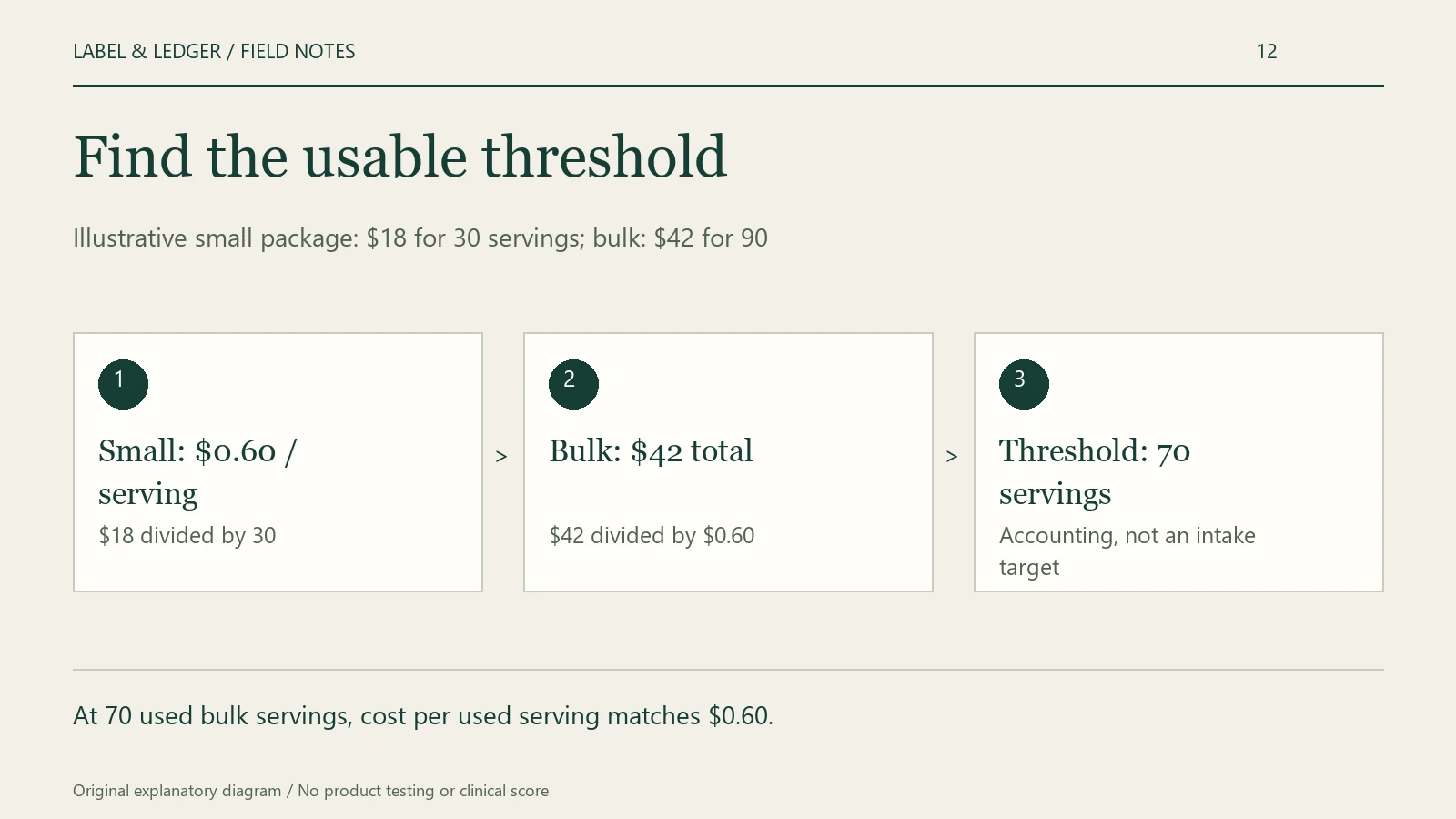
Suppose an illustrative small package costs $18 for 30 labeled servings and a bulk package costs $42 for 90. The small package costs $0.60 per declared serving. The bulk package costs about $0.4667 per declared serving. Buying three small packages would supply the same 90 declared servings for $54, ignoring other charges in this simplified scenario. The bulk cash difference is $12 against that matched supply.
That result assumes you need and can use 90 servings. If your question concerns only the next 30, the bulk option still requires $42 today rather than $18. The remaining servings are inventory, not an immediate cash refund. A fair table should show upfront cash, declared supply and expected usable supply rather than collapsing all three into a savings percentage.
Find the usable-serving threshold
Divide bulk net cost by the small package's cost per serving. In the illustrative pair, $42 ÷ $0.60 = 70 servings. If you use 70 of the bulk package's servings, its cost per used serving is $0.60, matching the small package's declared unit cost. More than 70 used servings lowers that particular metric; fewer raises it. This is a continuous accounting threshold, not a claim that individual small-package servings are sold separately.
| Illustrative bulk use | Bulk cash cost | Cost per used serving |
|---|---|---|
| 90 servings | $42 | About $0.4667 |
| 70 servings | $42 | $0.60 |
| 60 servings | $42 | $0.70 |
For actual purchase planning, whole packages matter. If you need 70 servings, small packages may require buying three bottles, leaving some inventory too. Compare the resulting cash schedules as a second analysis. The break-even threshold is useful for understanding waste sensitivity, but it does not replace a complete package-purchase plan for a defined period.
Estimate use without inventing a regimen
Use a personal plan established independently of the price calculation. Do not increase use to make the bulk purchase look efficient. If future use is uncertain, create several explicitly labeled scenarios instead of assuming perfect utilization. For example, you can compare using all the package, using two-thirds and stopping after one smaller-package equivalent. These fractions are assumptions chosen to inspect the decision, not predictions about your behavior.
Check the actual label date and storage instructions for the package you would receive when possible. Do not assume an online image guarantees a particular remaining shelf life. If receiving-date information matters to the quantity you can use, ask the seller. A bulk discount cannot compensate for missing identity or storage information when those details are essential to your decision.
Account for the value of flexibility
A smaller purchase may preserve cash and reduce commitment while you resolve practical questions. This does not make the smaller package universally better, nor does it require assigning an invented dollar value to flexibility. Describe the tradeoff in plain terms: lower upfront payment, fewer servings held, or lower declared unit cost. Some useful decision criteria do not need a numerical score.
If you are considering a new product, avoid treating a large package as a low-cost experiment merely because its serving price is lower. The amount you pay before learning whether you will continue using it is still relevant. Personal suitability belongs with a qualified healthcare professional. The purchasing analysis should follow that discussion rather than create an incentive to continue an unsuitable product.
Record the decision boundary
Finish your worksheet with a conditional sentence: this bulk option has a lower declared unit cost, and it matches the small package's unit cost if at least the calculated threshold is used. Then state the cash required and unresolved information. This is more informative than a single best value badge because it tells you which assumption could change the decision.
FAQ
Is the break-even point a recommended amount to consume?
No. It is an accounting threshold. It must never be used as an intake target.
What if the small and bulk formulations differ?
Keep separate rows and describe the difference. Do not present their unit prices as proof of substitutability.
Can I ignore unused servings because they were discounted?
You may calculate declared unit cost, but a usable-serving scenario should account for expected unused inventory explicitly.
Sources
- NIH ODS: Dietary supplements, what you need to know — general context for discussing supplement use. Break-even formulas and all prices above are original illustrative arithmetic.