How to compare supplement prices on a fair basis
Use a repeatable price worksheet that separates label quantities, checkout costs and assumptions without inventing a product ranking.
Compare supplement prices by matching the product quantity you care about, adding the actual checkout costs and stating every assumption. Start with cost per labeled serving, then calculate cost per gram of a named ingredient only when the label provides a suitable quantity. Keep formulation differences visible. A cheaper denominator is a shopping result, not proof of equal benefit, quality or suitability. This overview explains a repeatable process using illustrative arithmetic rather than live offers.
Define the decision before collecting prices
Write down whether you are choosing a package size of the same product, comparing different formulations, or estimating the cost of an existing plan. These are different tasks. Comparing two sizes of an identical formulation may need only package count and checkout details. Comparing different formulations also needs a careful ingredient record. Budgeting a plan needs a use assumption, which this website cannot determine for you.
Decide which fields are necessary before looking at discounts. This keeps an appealing offer from lowering your information standard. For an ingredient-level comparison, require a declared amount for that ingredient. For a refill comparison, require the future price conditions and delivery interval. If a critical field is missing, label the row incomplete rather than guessing it to preserve a price ranking.
Build a net-cost numerator
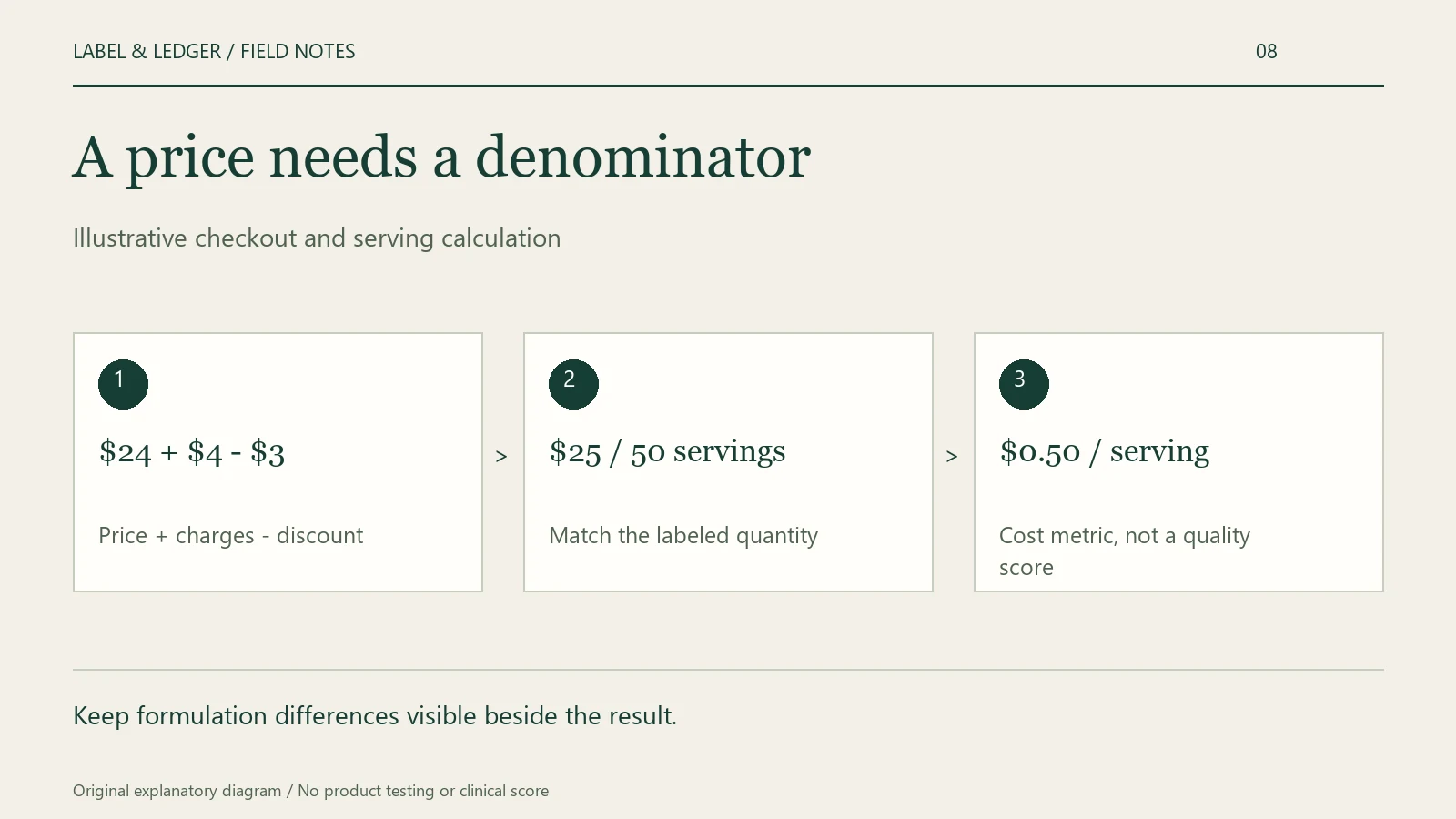
For one package, net cost equals listed price plus applicable allocated charges minus a real dollar discount. In an illustrative example, a $24 item, $4 in allocated shipping and tax, and a $3 coupon produce a $25 net cost. Record each component separately. That helps explain whether a change in unit cost came from the product price, checkout charges or a temporary offer.
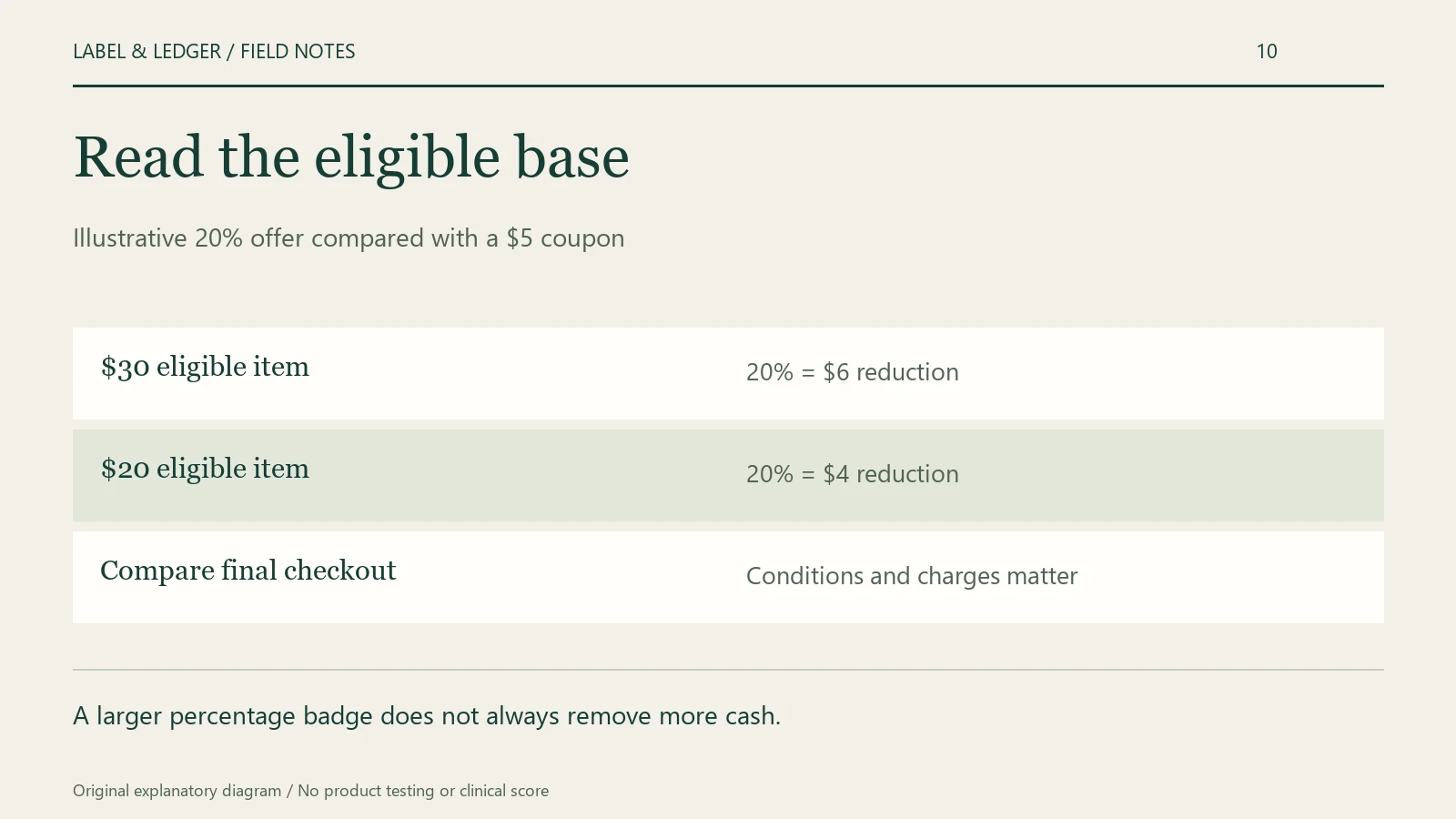
Do not enter a percentage as though it were a dollar reduction. Convert a percentage discount only on the eligible amount and check the checkout result. If the offer excludes some items or applies only before shipping, use the actual displayed savings. Keep gift cards, rewards and uncertain future rebates separate from immediate discounts unless your worksheet explicitly describes how they are treated.
Choose the denominator
Cost per labeled serving is net cost divided by labeled servings per package. For an illustrative 50-serving bottle at $25 net, that is $0.50 per serving. Cost per gram of a named ingredient requires its mass per serving and a unit conversion. If each serving declares 400 mg, total declared ingredient is 50 × 400 ÷ 1,000 = 20 g, giving $1.25 per gram.
| Metric | Formula | Question answered |
|---|---|---|
| Serving cost | Net package cost ÷ labeled servings | What does one labeled serving cost? |
| Ingredient unit cost | Net package cost ÷ declared ingredient grams | What does a gram of this named ingredient cost? |
| Consumption budget | Serving cost × assumed servings used | What cost is allocated to planned use? |
| Cash outlay | Packages purchased × checkout package cost | What money is paid during the period? |
Do not substitute total blend or powder weight for a specific ingredient merely to fill the denominator. Where the amount is unknown, the component-level result is unavailable. It is still possible to report serving cost while stating that the formulation comparison remains incomplete. A useful table can contain an honest blank.
Keep cash flow and consumption separate
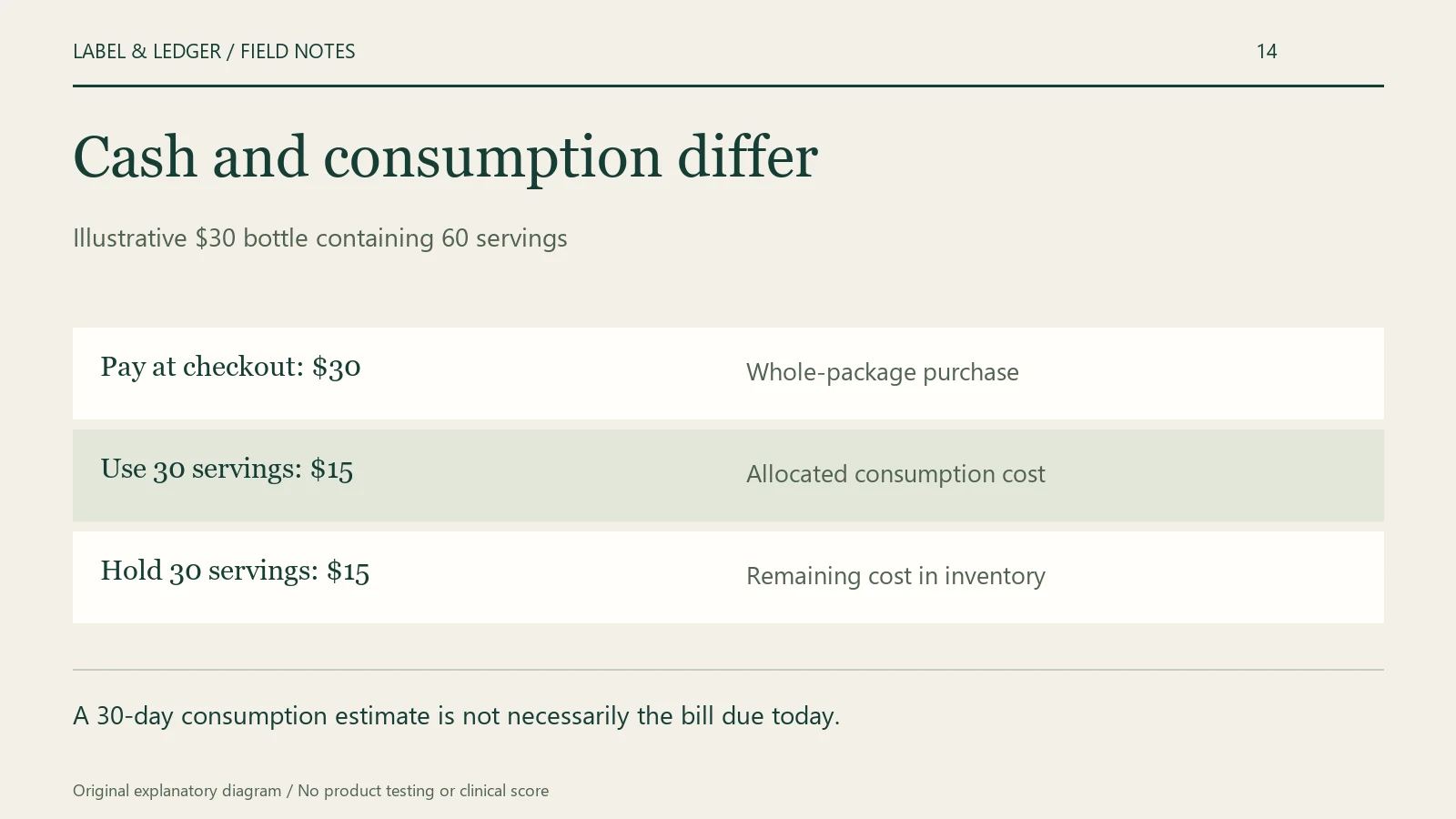
A 60-serving bottle bought for an illustrative $30 requires $30 at checkout even if you use only half its servings during the next 30 days. At an assumed one serving per day, $15 is the allocated consumption cost for that period. The difference is inventory you still hold, not a billing error. State both figures when planning a household budget.
For longer periods, estimate packages needed using the actual starting inventory and round purchases up to whole packages. A fractional bottle may be useful for allocating consumption but cannot necessarily be purchased. If you expect a price change or a different delivery fee, make a separate scenario rather than presenting the first observed checkout as a guaranteed future cost.
Test the result against real constraints
Consider whether the package is affordable today, whether you can use the expected quantity before the labeled date, and whether the format fits your circumstances. These are scenario questions rather than universal product scores. A bulk bottle can have lower declared serving cost while being less practical for someone with limited cash or uncertain future use. Describe the tradeoff without declaring one package inherently superior.
Ask a healthcare professional about personal suitability, overlapping products and medicine questions. The price worksheet should follow an appropriate use decision, not replace it. A lower unit price cannot establish a need for a supplement or justify increasing use. Keep clinical and shopping questions in separate notes so a neat cost result does not silently settle an unrelated health decision.
Save enough information to repeat it
Keep the exact variant, current label image, selected seller, checkout inputs and the date of your own capture. This site has not collected a live market dataset. If you revisit a comparison, verify the package and terms again before reusing its figures. A changed serving count can matter as much as a changed sticker price. Retaining the old row makes the reason for a difference visible.
FAQ
Is the lowest cost per serving the best supplement?
That conclusion does not follow. It is the lowest result only among the entered rows and assumptions, with formulation and suitability still separate.
Should shipping be included?
Include charges relevant to obtaining the product and disclose how shared charges are allocated. Use the same method for each comparable row.
Can I use the defaults as current prices?
No. They are invented, clearly labeled examples. Replace them with your own current package and checkout inputs.
Sources
- FDA: Questions and answers on dietary supplements — regulatory and product context. The cost formulas and scenarios above are original arithmetic, not FDA price data.
Continue your comparison
- Shipping and tax: include the checkout costs without double counting
- Coupon math: compare the final total, not the discount badge
- Supplement subscriptions: calculate the refill cost and interval
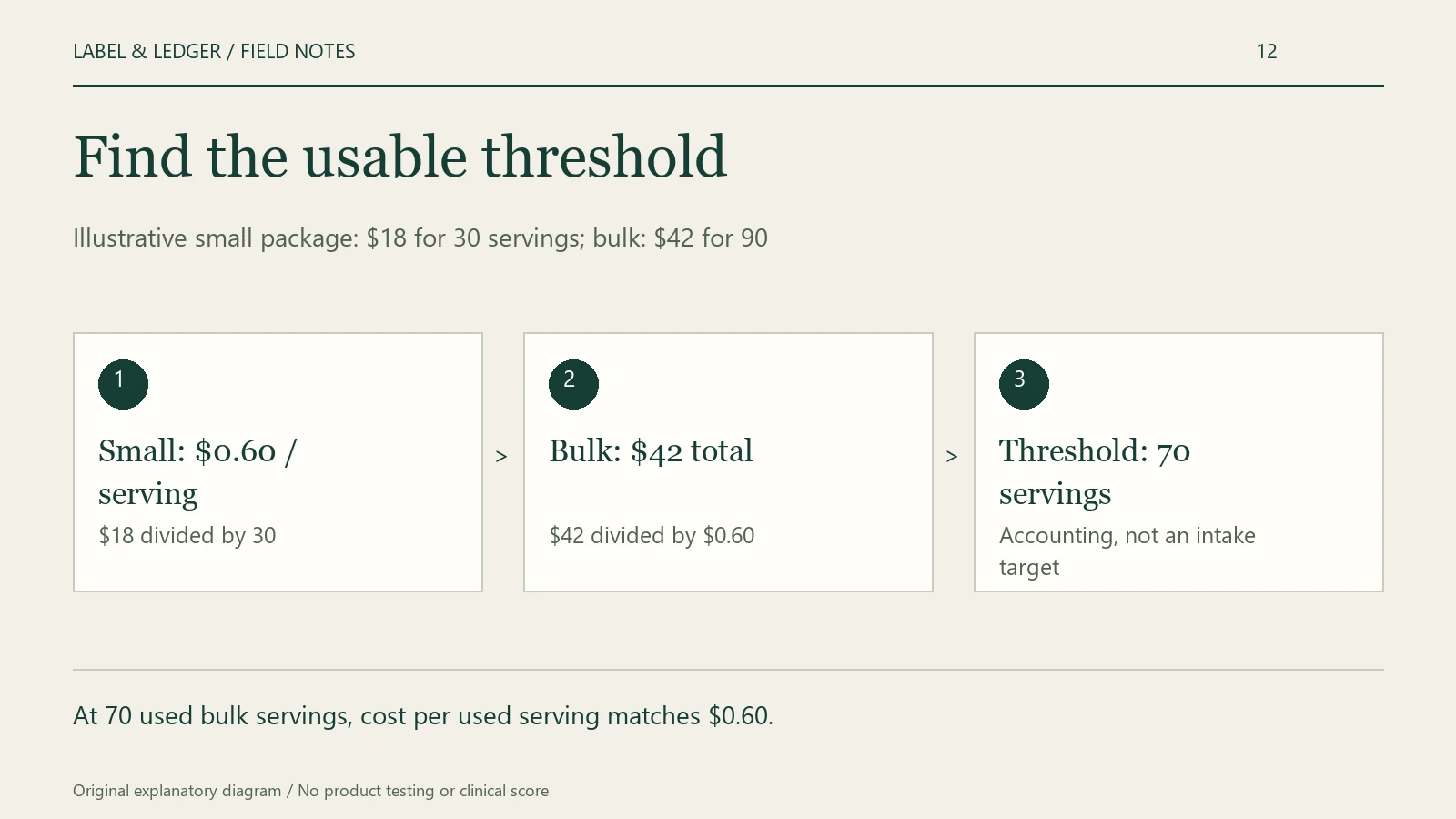
- Bulk supplement packages: find the usable-serving break-even point
- Unused servings and label dates: what your supplement really costs to use
- A monthly supplement budget: cash purchases vs. consumption cost
- Calculate cost per labeled serving
- Compare product types and denominators