Coupon math: compare the final total, not the discount badge
Translate percentage and dollar offers into comparable checkout costs while keeping eligibility, minimum spend and future rewards separate.
A coupon is useful to a supplement price comparison only after you establish which purchase qualifies and how much cash it actually removes from checkout. Compare final totals for the exact packages you intended to buy. A larger percentage badge can produce a smaller dollar saving, and a lower first-order price can coexist with a higher refill price. This guide uses invented offers to demonstrate arithmetic, not current promotions.
Separate the offer from the price record
Record the original item price, the eligible amount, the stated discount method and the final checkout reduction. Keep conditions next to the numbers: selected items, minimum purchase, quantity limit, first order or recurring order. If a condition is unclear, do not assume it applies. The retailer's final checkout and published terms are the relevant purchase record, not a search snippet showing an expired badge.
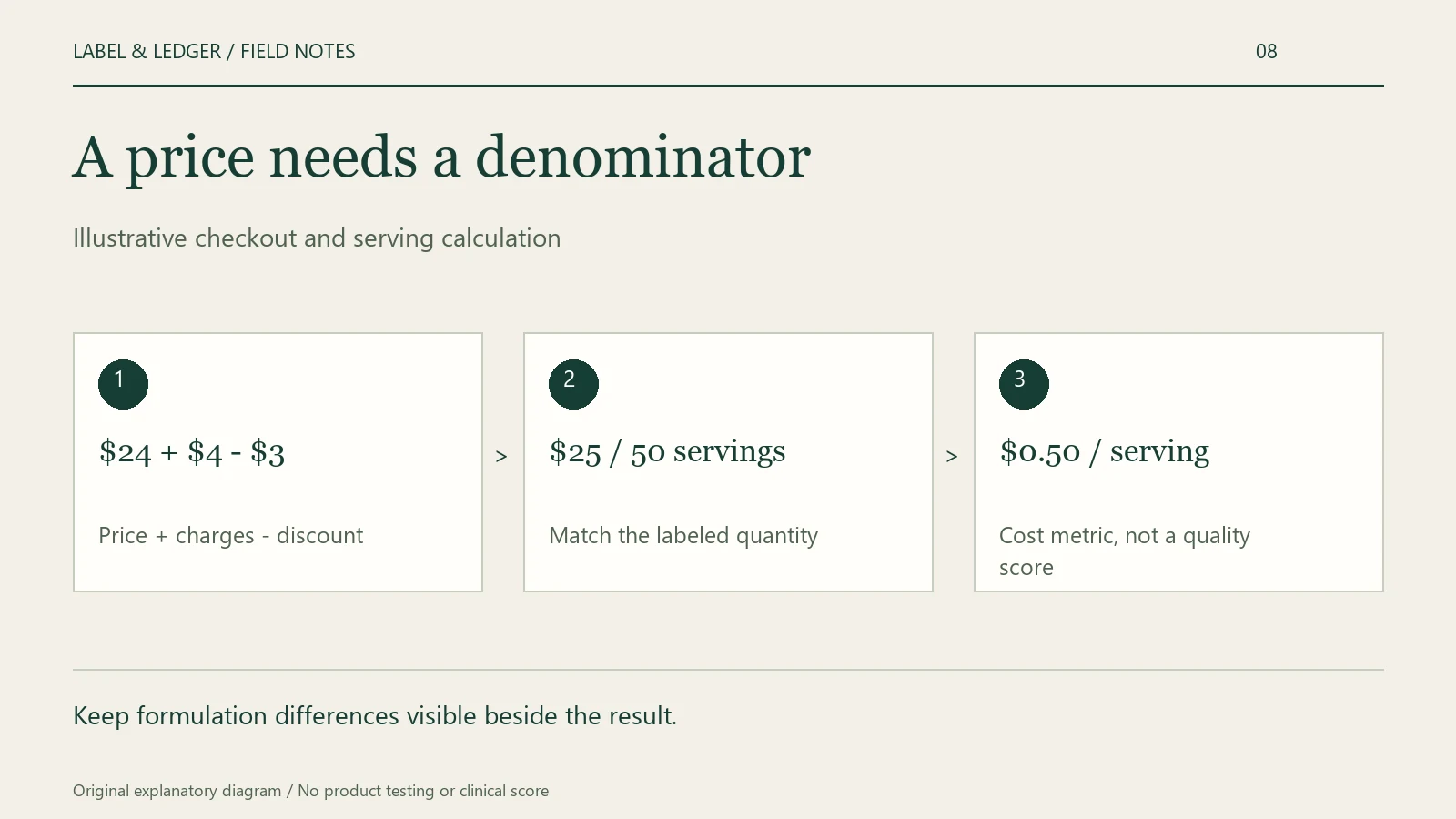
Use a dollar-discount field for dollar amounts only. If the offer says 20 percent off eligible merchandise, calculate the dollar reduction on the eligible merchandise and verify it at checkout. Do not enter 20 into a dollar field unless the actual reduction is $20. That unit mistake is easy to miss because both inputs look like ordinary numbers.
Compare percentage and fixed-dollar offers
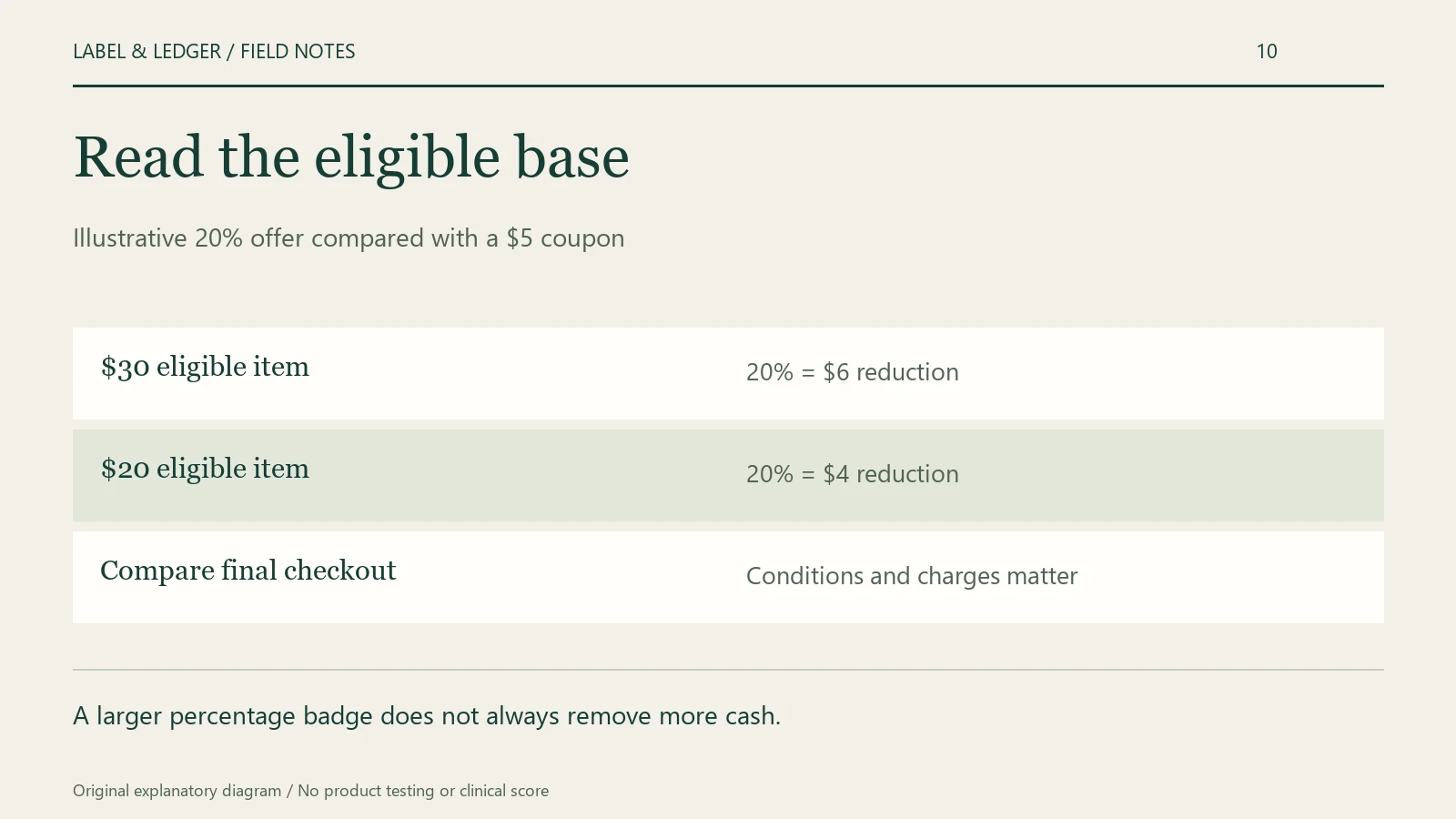
For an illustrative $30 eligible item, a 20 percent reduction is $30 × 0.20 = $6, leaving $24 before other charges. A $5 coupon leaves $25 before other charges. On an illustrative $20 item, the same 20 percent reduction is $4, so a qualifying $5 coupon would remove more cash. Which offer is larger depends on the eligible base and conditions.
| Illustrative eligible base | 20% reduction | $5 reduction | Lower item subtotal |
|---|---|---|---|
| $30 | $6 | $5 | $24 with 20% offer |
| $20 | $4 | $5 | $15 with $5 offer |
This table deliberately omits shipping and tax so the discount arithmetic is visible. For a real purchase, add the actual checkout charges and compare the complete payable totals. An offer that removes more merchandise cost may still have different delivery conditions. Do not assume that a discounted item has the same total cost through every seller or delivery method.
Do not assume discounts stack by addition
If an illustrative offer reduces a $40 eligible amount by 10 percent and then applies another 10 percent to the remainder, the result is $40 × 0.90 × 0.90 = $32.40. The combined reduction is $7.60, or 19 percent of the original $40. It is not automatically a 20 percent reduction. The actual sequence and permitted combination must come from the offer terms.
Some offers may not combine at all. Keep alternate checkouts as separate scenarios rather than applying every visible code in a spreadsheet. If the cart chooses one offer automatically, record that final result. A hypothetical stacked total is not a price available to you unless checkout and the relevant terms support it. Label any planning-only scenario accordingly.
Test minimum-spend conditions
Suppose an illustrative coupon removes $10 from a $50 merchandise purchase, while the item you intended to buy costs $32. Adding $18 of unplanned merchandise creates a $40 discounted merchandise total. You spend $8 more on merchandise than the original $32 plan, even though the coupon shows $10 saved. The extra items may have value to you, but the total is not lower solely because the coupon was applied.
Write down both the intended basket and the qualifying basket. Compare their full checkout totals, including any delivery differences. If the additional item was already part of a near-term plan, explain that assumption rather than treating it as free. This keeps useful purchasing choices distinguishable from a misleading savings label.
Keep future rewards outside immediate savings
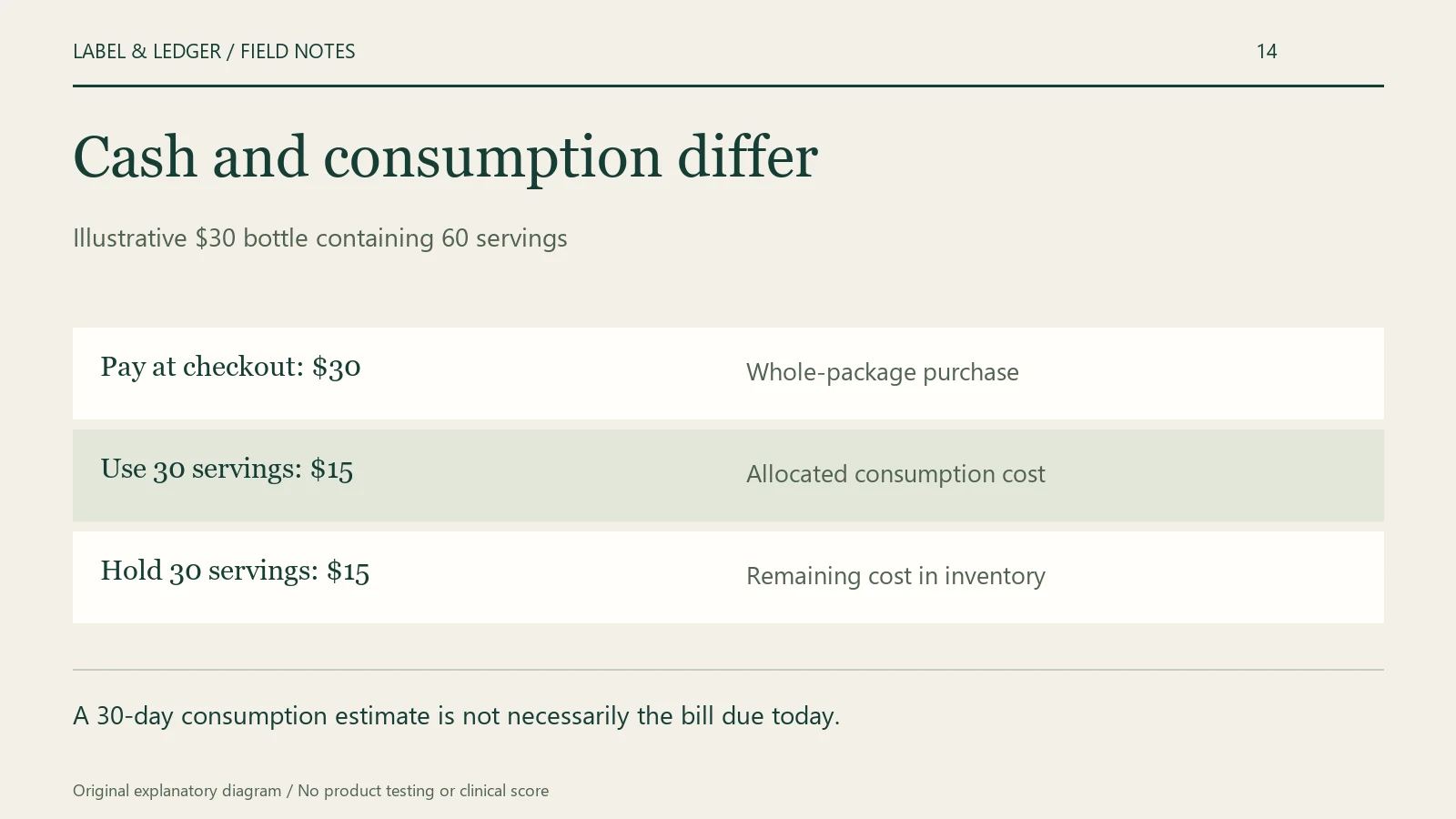
A reward usable on a later order is not the same as cash removed today. For a simple checkout comparison, show it separately with its conditions rather than subtracting it from the payable total. A future reward may expire, require another purchase or depend on eligibility. This guide does not assert any particular program's rules; check the actual terms of the offer you are evaluating.
You can build a second scenario in which you use a reward on a planned later purchase. Include that later purchase and its conditions explicitly. Avoid assigning full cash value to a reward you are unlikely to use. Also avoid counting it once as a discount on the first order and again on the second order. A two-order ledger makes double counting easier to detect.
Preserve the regular-price comparison
For a recurring purchase, calculate the initial order and the next order separately. Do not spread a one-time coupon across an indefinite number of refills without stating the chosen horizon. If you compare annual costs, list the assumed number of orders, the one-time reduction and the recurring package price. Future prices remain assumptions unless the relevant terms actually guarantee them.
FAQ
Is 20 percent off always better than $5 off?
No. The eligible price determines the dollar value, and conditions can change the final checkout result.
Can I subtract a future reward from today's bill?
Show today's payable cash separately. A future reward belongs in a conditional scenario rather than an unconditional cash reduction.
What if a coupon does not apply at checkout?
Use the checkout that is actually available. Do not retain the rejected discount as though it reduced your cost.
Sources
- Federal Trade Commission — official consumer-protection starting point. Examples are original arithmetic, with no claim that these offers are available.