Serving size vs. bottle count: why 120 capsules may mean 60 servings
Distinguish capsule count, labeled servings and days of supply so that package-size comparisons use the same denominator.
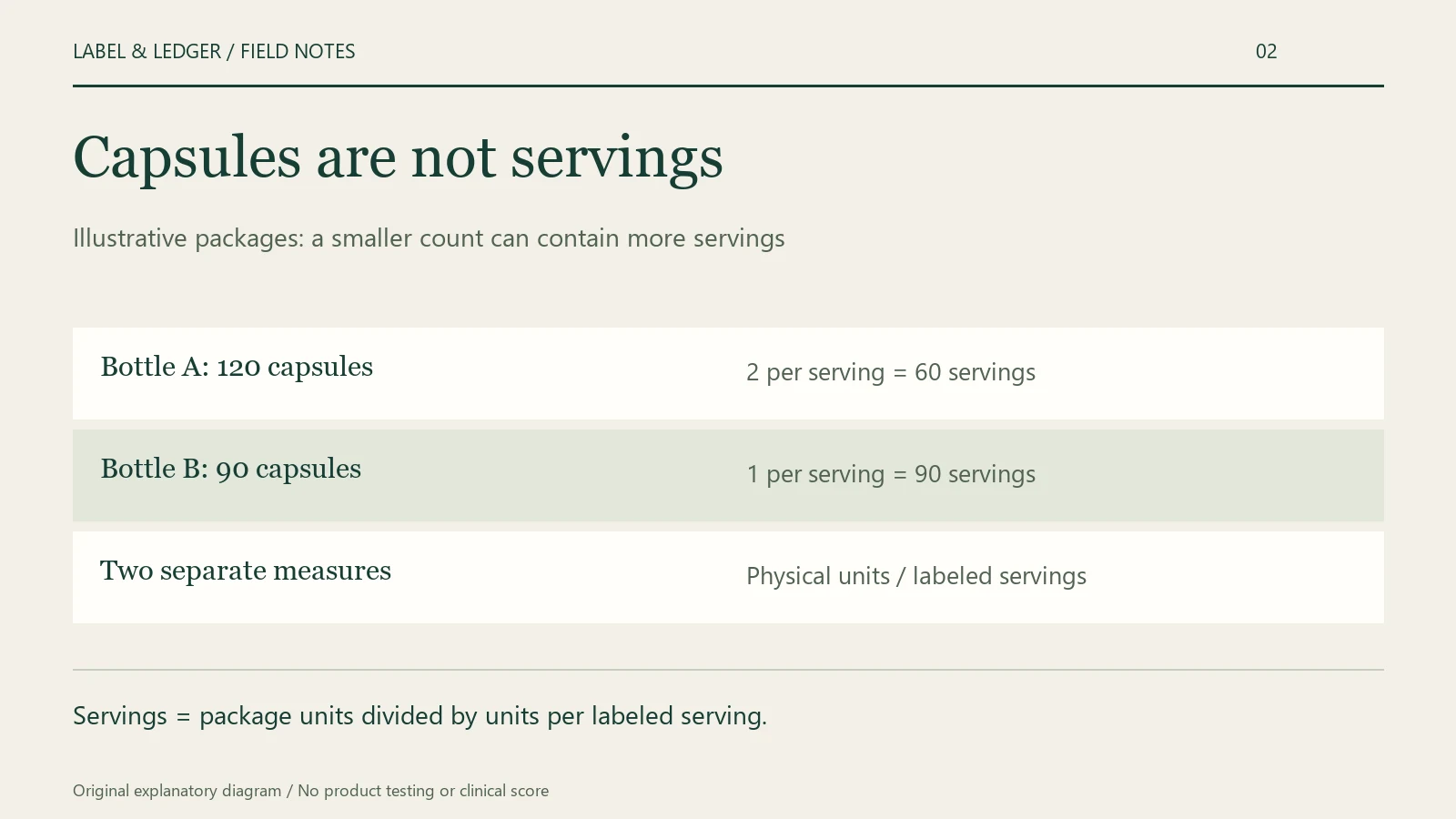
Bottle count tells you how many physical units are in a package. Serving size tells you how many of those units belong to one labeled serving. Divide the first by the second before comparing cost per serving. Days of supply require one more input: the number of servings used per day under an appropriate personal plan. These three measures are connected, but they should never be presented as interchangeable.
Write the units beside every number
An entry that says only 120 is ambiguous. It could mean capsules, grams or servings. Write 120 capsules, two capsules per serving and 60 servings per bottle on separate lines. This small habit catches mistakes before they reach the calculator. It also makes it easier to compare a capsule bottle with a tablet bottle without silently assuming they use the same serving size.
For powders, copy the labeled serving mass and the stated servings per container. A scoop is not automatically the same size across products. Do not estimate the number of servings from a photograph of the tub. If you use container mass divided by serving mass as a cross-check, keep the label's approximation language and allow for a stated rounding difference. Ask for clarification when the numbers cannot reasonably describe the same package.
Work through an illustrative pair
Suppose illustrative Bottle A contains 120 capsules, uses two capsules per serving and costs $24 before any other charges. It has 120 ÷ 2 = 60 servings, at $24 ÷ 60 = $0.40 per serving. Illustrative Bottle B contains 90 capsules, uses one capsule per serving and costs $27. It has 90 servings, at $0.30 per serving. The bottle with fewer capsules has the lower serving cost in this invented example.
That result is only a serving comparison. It does not establish that A and B contain the same ingredient amount, use the same form or serve the same purpose. Add those fields before describing one as a cheaper substitute. A good comparison can state both facts: B costs less per labeled serving, while the formulations remain different and their suitability has not been assessed.
| Illustrative package | Capsules | Capsules per serving | Servings | Cost per serving |
|---|---|---|---|---|
| A at $24 | 120 | 2 | 60 | $0.40 |
| B at $27 | 90 | 1 | 90 | $0.30 |
Keep a supply estimate separate
At an assumed one serving per day, A's 60 servings represent 60 days. At an assumed two servings per day, the arithmetic would give 30 days. Those are budgeting scenarios, not suggested use. Increasing the daily-use field to make the package fit a refill schedule is not an appropriate reason to change actual intake. Obtain personal guidance separately and then use the relevant assumption for budgeting.
Supply estimates can be useful even if you do not use a product every day. Write the expected total servings used during your chosen period rather than forcing an irregular schedule into an apparently precise daily habit. If you are uncertain, show a range of scenarios in your notes. A supply calculation should expose uncertainty rather than turn it into a false prediction.
Watch for bundles and mixed units
A two-bottle bundle requires two clear counts. First calculate the servings in one bottle, then multiply by the number of identical bottles. Check that the bundle does not mix different sizes, flavors or formulations. A photograph of two bottles is not sufficient evidence that the selected offer includes both. Read the item description and checkout line before doubling the denominator.
A kit with different morning and evening products is a different problem. Do not add the capsule counts and call the sum servings. Record the supplied units of each component and the kit's stated arrangement. For a budget, the limiting component may determine when another kit would be needed. If the label does not explain the intended arrangement, leave that interpretation to the manufacturer and a qualified professional.
Use a two-pass comparison
On the first pass, verify arithmetic: package units divided by units per serving equals labeled servings. On the second pass, verify identity: the same package, same formulation and same selected offer supplied all the numbers. Most spreadsheet mistakes are easier to spot when these checks happen separately. Changing three cells at once makes it difficult to identify which assumption moved the result.
Save both unit cost and total cash cost. A bulk package may have a lower serving cost while requiring more money today. Neither measure should replace the other. If a smaller package is the only affordable purchase, that is a budget constraint, not an arithmetic error. If a larger package may go unused, its advertised supply is not necessarily your usable supply.
When a denominator should stay unknown
Do not guess units per serving from a similarly named product. Do not borrow the serving size from an older label without checking the version. If a seller provides contradictory photos, request a readable current label for the exact package. You can still record the listed bottle price, but mark serving cost as unresolved. An incomplete calculation is preferable to a complete calculation based on the wrong product.
FAQ
Does servings per container mean days per container?
Only under an explicitly stated one-serving-per-day assumption. Supply days depend on use, and this guide does not determine use.
Should I round fractional serving counts down?
Preserve the label's stated count and any approximation. If you derive a count from mass, explain that method and avoid false precision.
Can a one-capsule serving be stronger than two capsules?
Capsule count alone cannot answer that question. Compare the exact declared ingredient amounts and ask a professional about suitability.
Sources
- FDA: Supplement Facts nutrition labeling guide — serving and nutrient labeling reference.