Comparing proprietary blends when individual amounts are missing
Learn what you can calculate from a blend label, which ingredient comparisons remain unresolved and what to ask before buying.
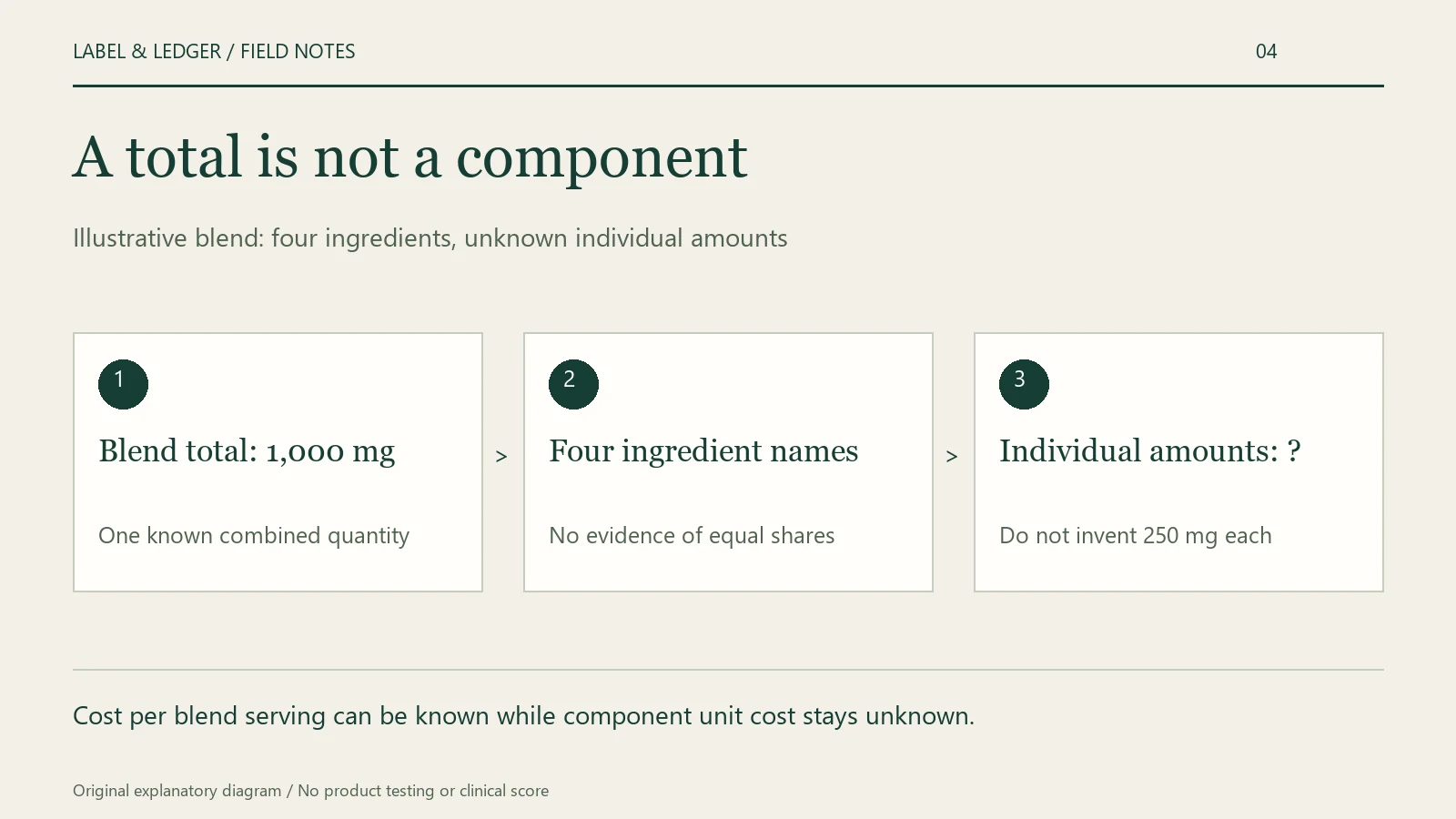
When a blend label does not quantify an individual ingredient, you cannot calculate that ingredient's cost per gram from the blend total alone. You can compare the cost per labeled serving of the whole formulation, while clearly marking the individual amount as unknown. Dividing a total evenly among ingredient names would invent information. The practical task is to distinguish the calculation you can support from the question that still needs an answer.
Define exactly what is missing
Copy the blend name, total declared amount, serving size and ingredient list into your notes. Then circle the particular ingredient you hoped to compare. Ask whether its amount is separately stated anywhere on the current package. Keep front-label statements, seller answers and Supplement Facts observations in separate fields. This prevents an informal marketplace answer from becoming an apparently verified label fact.
A missing amount is not a number close to zero, nor is it an equal share of the total. It is an unknown. In a spreadsheet, leave the ingredient-cost result blank with a written reason rather than entering zero. Zero may be interpreted by a sorting formula as free, while a guessed amount creates artificial precision. Use an explicit unavailable status if your comparison system supports it.
Understand why equal allocation fails
Consider an illustrative blend with a total mass of 1,000 mg and four listed ingredients. Dividing 1,000 by four gives 250 mg, but that is only the average of four hypothetical equal parts. The label total does not establish equal parts. Many different combinations could add to the same total, so the arithmetic supplies no evidence of any component's actual amount.
This is a mathematical information problem rather than a reason to declare a product good or bad. You may decide that the missing detail matters enough to remove the item from your shortlist. Another shopper may have a different comparison question. Either way, avoid presenting an invented component amount as a product fact or turning incomplete disclosure into an unsupported claim about safety.
Use a whole-formulation comparison honestly
You can divide the exact package cost by the stated servings. Suppose an illustrative $36 bottle has 30 servings of a blend. Its price is $1.20 per labeled serving of that formulation. The result does not tell you how many milligrams of the component of interest are supplied for that $1.20. Write that distinction directly beside the result so it survives a screenshot or shared worksheet.
| Question | Can the available inputs answer it? | Appropriate entry |
|---|---|---|
| Cost per labeled blend serving | Yes, if cost and servings are known | Net price divided by servings |
| Cost per gram of a component | No, if its amount is absent | Unavailable: component not quantified |
| Clinical effect of the combination | Not from shopping arithmetic | Requires relevant evidence |
| Suitability with medicines | Not from the total blend mass | Ask a qualified professional |
Ask the manufacturer a reproducible question
Identify the exact product variant and package. Ask for the amount of the named ingredient per labeled serving in that formulation, and request a current written label or specification supporting the answer. A question that says only how strong is it invites ambiguous language. A question naming ingredient, amount, unit and serving basis is easier to answer and easier to check.
Keep the reply date and its scope in your own records. An answer about one flavor or older formula may not apply to the item in your cart. If the manufacturer declines to provide an amount, preserve that response without translating it into a guess. You can then decide whether cost per whole serving is sufficient for your purpose or whether the unresolved quantity prevents a useful comparison.
Separate evidence about an ingredient from evidence about a blend
A link to research on a component does not, by itself, describe the exact combination you are shopping for. Record what product or intervention the research actually examined, if that can be established. Ask whether the seller's statement addresses the full formulation, one component, a laboratory experiment or a different population. These questions organize research; they do not make you a clinical reviewer.
When a claim would affect treatment, symptoms or medicine choices, bring the actual formulation and claim to a qualified healthcare professional. Do not assume that a familiar ingredient name makes an unknown amount harmless or effective. The blend total should not be used to override personal advice. A decision to postpone purchase while clarifying information is an acceptable outcome.
Build a shortlist with an information threshold
Before looking at prices, decide which fields are essential to your question. For example, a comparison of a single named ingredient could require a declared amount for that ingredient. A comparison of package cost for an already specified formulation may use a narrower set of fields. Defining the threshold first avoids relaxing it only because an attractive discount appears.
Use the same threshold for every product in the table. Keep excluded products in a separate note with the specific reason, such as ingredient amount unavailable, instead of assigning a poor quality score. That gives you a clear follow-up if new information arrives. It also avoids implying that your worksheet has conducted safety testing or a comprehensive product assessment.
FAQ
Can ingredient order tell me the exact amount?
No. An order is not a numerical disclosure of every component. Do not derive exact milligrams from position in a list.
Is the entire blend weight usable in the ingredient calculator?
Only if your question is explicitly about the whole blend mass. It must not be labeled as the mass of a single component.
Should every unknown lead to rejection?
That depends on the question and its importance. Mark the gap first; do not hide it inside an apparently complete cost result.
Sources
- FDA: Supplement Facts nutrition labeling guide — reference for blend and quantitative label information.