Mineral amount vs. compound weight: choose the right number
Avoid mixing the amount of a named mineral with the weight of its source compound when building an ingredient price comparison.
For a comparison about a named mineral, use the declared amount of that mineral on the Supplement Facts panel, while recording its source form separately. Do not automatically use a larger compound-weight statement from the front of a package. A source compound and the mineral it contains are different quantities. Getting the denominator right is necessary for fair arithmetic, although it still does not establish which form is appropriate for you.
Distinguish the two questions
The first question is how much of the named mineral is declared per serving. The second is which source or form the product uses. Both may matter, but only the first directly supplies the mass denominator for a cost-per-gram comparison of that mineral. Keep two columns rather than compressing them into a single strong-sounding product description. This also helps a healthcare professional see exactly what you have compared.
A product title may emphasize a chemical name, a serving amount or a branded formulation. Do not assume that the prominent number refers to the same thing as the panel amount. Read the wording around each number and ask the manufacturer to explain a discrepancy. Avoid reconstructing the mineral amount from a compound name unless you have a reliable, applicable specification and a reason to perform that separate technical calculation.
Build an illustrative comparison
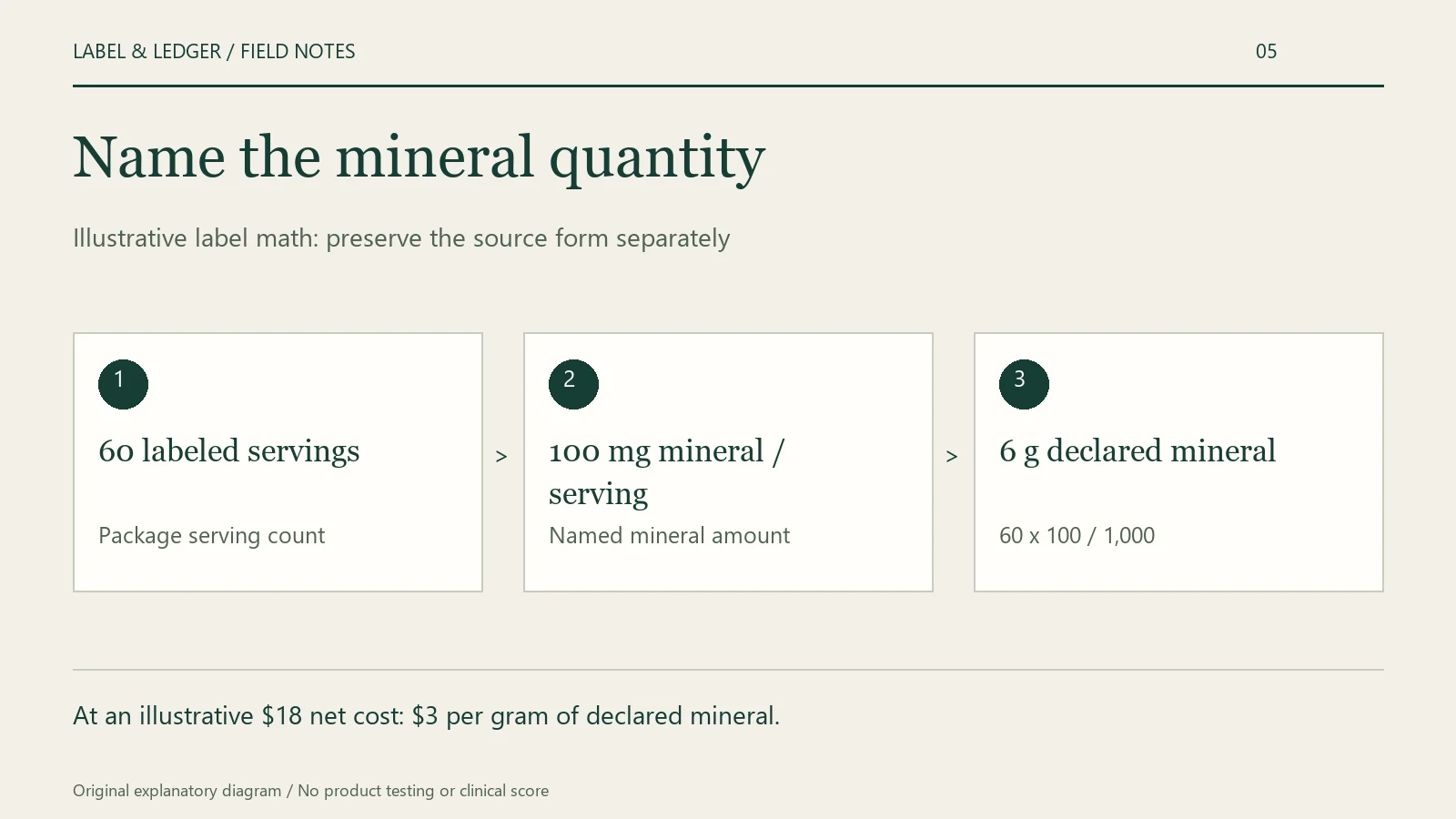
Imagine a bottle with an illustrative net cost of $18, 60 labeled servings and 100 mg of a named mineral per serving. Its declared mineral total is 60 × 100 mg = 6,000 mg, or 6 g. Cost per gram of that declared mineral is $18 ÷ 6 = $3. Cost per serving is $18 ÷ 60 = $0.30. The two results use the same purchase cost but answer different questions.
Now imagine a second label declaring 200 mg per serving, with 30 servings and the same illustrative $18 cost. It also supplies a declared total of 6 g, so the cost per gram is again $3, but its labeled serving cost is $0.60. This does not show that a person should change serving size. It demonstrates why a price statement should always specify its denominator.
| Illustrative package | Servings | Mineral per serving | Total mineral | Serving cost |
|---|---|---|---|---|
| A at $18 | 60 | 100 mg | 6 g | $0.30 |
| B at $18 | 30 | 200 mg | 6 g | $0.60 |
Preserve form information
Do not remove the source-form column just because both rows contain the same mineral total. NIH ODS publishes ingredient-specific fact sheets, including magnesium, that discuss forms and relevant considerations. A general shopping calculator cannot evaluate absorption or predict effects from the form name. Its output should be described as dollars per gram of the declared mineral, with the form difference still visible.
If a seller makes a specific superiority claim, record the wording and look for evidence that addresses that claim. A statement about a form in general may not describe the exact product or your situation. Avoid translating marketing adjectives into a numerical absorption factor. Multiplying a declared amount by an invented percentage produces a more complicated but less defensible price comparison.
Check combination products and overlap
A mineral may appear in a single-ingredient bottle and in a multivitamin or combination product. Copy the actual amount from each relevant label rather than assuming the same category name means the same composition. A combination purchase raises two separate issues: its total cost and the personal implications of using multiple products. Only the cost issue belongs in this calculator.
Prepare a complete product list for a pharmacist or other qualified healthcare professional if you use medicines or several supplements. Include the serving amounts and your actual use. Do not use a favorable unit price to justify adding a duplicate mineral. This guide supplies no universal intake target, and the illustrative quantities are not recommended doses for any age or condition.
Handle ambiguous front-label statements
When a front label and panel seem inconsistent, do not choose whichever value creates a better bargain. Write both statements verbatim in your private notes, identify the package variant and ask the manufacturer which quantity each describes. Save a readable image of the full panel. A cropped image can hide the serving size or a qualification that explains the apparent mismatch.
If the answer remains unclear, present cost per labeled serving only, with a note that mineral unit cost is unresolved. This keeps your worksheet useful without pretending to know more than the available information supports. A comparison can be complete in its method while openly incomplete in the product details. The missing field is a concrete next question, not a reason to improvise.
Check the arithmetic independently
Before accepting a result, multiply servings by the per-serving mineral amount by hand. Convert mg to g once, then divide cost by that total. Reverse the calculation by multiplying cost per gram by total grams; it should return the net bottle cost within rounding. This quick audit catches a per-capsule versus per-serving mistake and the common thousand-fold conversion error.
FAQ
Is the largest printed number the best denominator?
No. The wording and serving basis determine what the number represents. Use the specific quantity your comparison is about.
Can I rank mineral forms by cost alone?
You can report a price metric, but price does not establish equivalence, absorption or personal suitability.
Where should I research a particular mineral?
Use an ingredient-specific official reference and discuss personal questions with a qualified healthcare professional rather than borrowing a generic target.
Sources
- NIH ODS: Magnesium consumer fact sheet — ingredient-specific information about magnesium and forms.
- FDA: Supplement Facts nutrition labeling guide — label quantity reference.